Carmalized Onion, Feta, and Tomato Pastry Cups

Carmalized Onion, Feta, and Tomato Pastry Cups

Feeling Alive Again

There are moments in life when something inside you wakes up, stretches its limbs, and reminds you that you’re still here. Not just existing. Alive. Truly, wildly, soul-deep alive in a way you haven’t felt in years.

That’s where I am right now.

I put a dream out into the universe not long ago — quietly, intentionally — the way you release something you love with both hope and surrender. And the universe, in its own perfect timing, whispered back. Maybe feeling alive begins long before the dream comes true. Maybe it starts the moment you choose to believe you deserve more than survival. The moment you stop waiting for life to happen, and you start making it.

And this week, that truth unfolded in the most beautiful way.

My happy place has always been the kitchen. Gateway especially. The energy there, the purpose behind every event, the hum of creative momentum — it all feels like home. When I’m in that kitchen, feeding people and working alongside someone who understands my rhythm, everything in me settles.

This week was a whirlwind, but the best kind:

Wednesday we shopped.
Thursday we prepped.
Friday we transported everything and set up the Christmas party.

Three days of movement, intention, laughter, planning, and purpose. Three days of feeling more alive and grounded than I have in so long.

And at the center of it was Caryn.

The day we met! (2017) With the great Natasha Kwan.


Gateway Christmas Party. Covered in glitter and lipstick! (2025)


Eight years ago, I reached out to her because she felt like someone I was meant to know. I didn’t question it — I just followed that quiet inner pull that whispered, “Pay attention.”

Four months ago, I reached out to her again and asked her to be one of my chef’s at Gateway. We’ve been told we look like sisters. Maybe we do. But the deeper truth is that she feels like someone my soul recognized before my mind ever caught up.

One of my favorite things we made for the party were these simple vegan pastry cups — caramelized onions, vegan feta, and tomatoes. Nothing dramatic, nothing complicated, just humble ingredients layered together in a way that somehow became magic.

It struck me as we worked:
That’s life.
That’s friendship.
That’s purpose.

Simple things — a moment, a conversation, a shared task, a single decision to reach out to someone eight years ago — come together slowly, quietly, intentionally. And before you realize what you’re building, they become something bigger than the sum of their parts. Something meaningful. Something whole. Something that feeds you in ways you didn’t even know you were hungry for.

Just like those cups:
each ingredient good on its own,
but together — something elevated, something complete.

And somewhere in the middle of all of it — the prepping and unloading pans, the ovens heating up, and the music playing in the kitchen while we worked side by side — I realized something I didn’t expect:

Gateway is my new love.

Not a crush.
Not a phase.
A real love — grounded, steady, awakening.
The kind that lights you up in places that had quietly gone dim.
The kind that feels like purpose.
The kind that feels like home.

Last night, surrounded by good food, intention, and someone who feels like a sister from another lifetime, I felt humbled when Caryn thanked me. I felt grounded. Connected. Seen. We built something together — not just a menu, not just a party, but a moment that reminded me how much I love this life I’m creating.

Feeling alive again isn’t luck.
It’s courage.
It’s intention.
It’s collaboration.
It’s choosing yourself.
It’s trusting that the universe meets you where you’re brave.

And after three full days of pouring our hearts into something beautiful, I felt that spark again — that joy, that deep knowing:

I’m exactly where I’m supposed to be.

Just Egg Quiche with Breakfast Potato Crust, Beyond Sausage, Kale & Paprika Chèvre

Just Egg Quiche with Breakfast Potato Crust, Beyond Sausage, Kale & Paprika Chèvre

Breakfast Is My Love Language

There is something about breakfast that has always felt like home to me.

Maybe it’s because it reminds me of my grandma — those slow, soft mornings when I would wake up to the smell of something warm drifting through the house. Before my eyes were even fully open, the promise of breakfast was already calling me into the kitchen. It wasn’t just food; it was comfort, security, and the purest kind of love. The kind you don’t need to name or explain, because you feel it the moment you step into the room.

My daughter was home from college for the holiday recently, and I watched her do the same thing I used to do at my grandma’s house. She came downstairs, wrapped in a blanket, hair messy from sleep, breathing in the smells coming from my kitchen. And in that moment, time folded in on itself. I saw my younger self, and I saw her, and I realized that memories and food are threads that bind generations together.

That’s really what cooking has always been for me — my quiet way of saying I love you.
How do you say “I love you” without saying it?

You ask, “Are you hungry?”

You put an extra scoop on their plate. You make the good coffee. You stir slowly, season gently, fold in the ingredients like they’re made of memory. Food is the language my hands speak even when my heart is too full for words.

This breakfast casserole is exactly that kind of meal. Warm. Comforting. Cozy in a way only the holidays can be. It fills the kitchen with the kind of smells that pull everyone to the table, sleepy and smiling. And instead of using a traditional pie crust, I pressed crisp breakfast potatoes into the bottom of the dish — a hearty, golden base that feels rustic and homey, like something my grandma would’ve made without even thinking twice. It gives the casserole this satisfying, almost nostalgic foundation that tastes like the mornings I grew up with.

I love the addition of the Rebel Cheese paprika chèvre — it melts into these gorgeous creamy pockets of smoky, tangy goodness. But if you don’t have it, you can absolutely use Violife feta and add a teaspoon of paprika. It still gives you that savory little spark.

Breakfast will always be my favorite meal, not because of the food itself, but because of what it carries with it: memories, connection, love passed down in the language of “eat, baby.”

The holidays are cozy to me — soft blankets, warm kitchens, people I love drifting in and out, always asking what smells so good. And if I can give them even a sliver of the comfort my grandmother gave me, then that’s the real recipe.

Because breakfast isn’t just breakfast.
It’s home.
It’s love.
And it’s the first “I love you” of the day.

Rooted

Rooted

As I near the year’s end, I’ve been doing a great deal of reflecting.
There’s something about standing at the edge of a chapter — still holding what was, while slowly turning toward what will be — that makes you look at your life with clearer eyes.
And this year, clarity came in waves.

This year has been about standing in my truth —
even when my heart felt torn,
even when other people’s emotions swirled around me like storms,
even when everything in me wanted comfort instead of growth.

I refused to be pulled out of my purpose by anyone else’s immaturity or lack of awareness.
I learned that I can be the tree:
my branches may sway in the wind,
but my roots do not move.

I see people.
I study them.
I can read the quiet shifts in energy before they ever speak.
I can sometimes predict a person’s behavior before they act, not because I’m magical, but because I’ve lived enough life to recognize the rhythm of human patterns.
And I’ve learned to trust what I sense.

I have been burned.
I carry scars, and some of them still ache.
I have been yelled at, embarrassed, dismissed, bruised, and neglected.
I’ve had moments where life brought me to my knees.
But in those shadows, I found others like me —
other survivors, other fierce women
who finally stood up to the people who underestimated them and said,
Not anymore.

I’ve had to prove myself.
My loyalty has been tested.
My patience has been stretched to its breaking point.
And through all of it, I kept showing up.
Through my strength, I became respected.
Not because I demanded it,
but because I embodied it.

I have been invited to tables I once stood outside of.
I have kept my wits in rooms designed to shake me.
I have kept my composure when falling apart would’ve been easier.
And I have earned trust — not through perfection, but through consistency.

This year, I also found myself stepping away from chapters that defined me for decades.
When you spend nearly 25 years walking beside someone, it shapes you.

But sometimes, without blame or bitterness, you realize that a path you have walked for so long is no longer the one your soul can continue on.
Sometimes the bravest thing you can do is gently step back from what has been familiar
and choose yourself again.

Quietly.
Respectfully.
Truthfully.

Life has a way of showing you when you’ve outgrown something… or when you’ve finally grown into yourself. And I realized that I have leveled up—emotionally, spiritually, energetically. I am no longer willing to stay in places where my spirit must shrink to fit. Some paths end not with anger or blame, but with a deep exhale and the understanding that your soul is ready for more.

I don’t rise or fall according to someone else’s storms anymore.

When you ask, you shall receive. I asked to grow, to see the truths that had been quietly holding me back.
I asked to rise, to evolve, to expand in ways I wasn’t yet ready to understand.

And life answered.

Not through ease or comfort, but through the exact lessons that would strip away every illusion I still clung to. Through people who tested my boundaries, through moments that shook me awake, through situations that forced me to stand in my own power. I learned not to react when others wanted me to fail, not to absorb the wounds they tried to hand me. Their pain is not my responsibility, their projections are not my story.

I leveled up—not because of a job, not because of a man, not because of validation from anywhere outside of myself—but because something inside me finally aligned with the spiritual love that has always been mine. The love that moves quietly beneath everything. The love that asks nothing except that I show up as truth, as balance, as authenticity, and as reciprocity.

Going forward, the energy I call in is equal. Equal friendships. Equal partnerships. Equal work. Relationships and places that meet me where I stand, that support me as deeply as I support them. A shared reflection. A mutual rising.

This is the path I asked for.
And I’m walking it now—eyes open, heart steady, spirit unshakeable.

Every heartbreaking moment,
every painful lesson,
every disappointment,
every betrayal,
every silence
was preparing me —
not punishing me.

Growth is rarely soft.
It hurts.
It cracks you open.
It pulls you from your comfort.
It demands that you shed the versions of yourself that survived,
so you can become the version that thrives.

This year, I broke patterns that no longer belonged to me.
I stepped away from situations that didn’t feed me anymore —
and some that never fed me at all.
I stopped confusing familiarity with nourishment.

And I learned to hold onto myself.

I do not make other people’s problems my problems anymore.
I no longer absorb what was never mine to carry.
I can care without carrying.
I can love without losing myself.
I can witness without becoming wounded.

Their storms are not my storms.
Their chaos is not my calling.

I am steadfast now,
not because my life has been easy,
but because I allowed it to shape me into someone stronger than my circumstances.

I know who I am.
And I am done apologizing for the fire it took to become her.

So here I stand—rooted, rising, and finally aligned with the woman I was always meant to become.
I am no longer shrinking to fit old stories or old versions of myself.
I am no longer bending under the weight of other people’s expectations.
I am choosing a life built on truth, reciprocity, and grounded joy.
A life where I am met, not managed; supported, not drained; cherished, not tolerated.

I am stepping into this next chapter with my head high, my heart open, and my roots firm in the earth beneath me.
Whatever comes next, I will greet it with the same courage that carried me through every fire before this one.
Because I know who I am now.
And I finally trust that the world ahead of me will rise to meet that truth.

Anchored by Courage

Anchored by Courage

Next week, my son — my second born, my first boy — will be sworn into the United States Navy.

It’s hard to even type that without feeling every version of him flash through my mind. The gorgeous baby who seemed perfectly fine until around 18 months… when the world suddenly became too loud, too bright, too overwhelming for him. When my sweet boy started having emotional outbursts I didn’t yet understand. When his little brain locked onto things the way only he could — obsessive, hyper-focused, determined — even when his words couldn’t quite keep up.

For a while, he spoke in his own language. A language only he and my mom understood, because she never tried to correct him or make him fit the world. She just met him where he was. Those two bonded in this magical, gentle way that still brings tears to my eyes.

Leaving him anywhere was impossible. Even the gym drop-off — I’d hear him crying for me from across the building, screaming in panic until I came back to hold him. Eventually I hired a nanny so he could stay home where he felt safe. And little by little, through preschool and with so much love and patience, he began to blossom. That’s around the time we finally got answers. Asperger’s Syndrome.

Elementary school was okay… but even then, his teachers and counselors noticed how different the world felt for him. And to this day, they still ask about him. Every single one of them said the same thing:
he had the kindest, sweetest soul — he just struggled to fit in.

Middle school and high school were harder. Traumatizing at times. The world didn’t always give him grace. Kids didn’t always give him space. And still — he kept going.

Then came the moment he had dreamed about his whole life: joining the military.
He wanted to be a soldier from the time he was old enough to speak.

But the Army rejected him — not because he wasn’t capable, not because he lacked courage, but because he had once seen a counselor to help him navigate his emotions and anxiety. Because he took medication for a while to cope with the weight of the world on his young shoulders.

Imagine telling a young man that choosing to get help disqualifies him.
It broke something in him.
And it broke something in me.

But life has a way of putting people exactly where they belong.

When we walked into the Navy recruiting office, they were shocked by the rejection. They said it was an absolute shame — that someone trying to understand themselves, to get healthy, to process their feelings, would be punished for it. And in that moment, I knew:
the Navy was his home.

They saw his strength.
His resilience.
His heart.
They saw the man he has become — not just the struggles he once had.

And next week, this same boy who once couldn’t let me out of his sight…
this boy who fought through sensory overload, misunderstandings, and so many silent battles…
this boy who kept standing back up…is raising his right hand and swearing in to serve our country.

There are a thousand kinds of courage in this world. But choosing to rise from a hard beginning, choosing to walk a path that wasn’t built for you, choosing to serve despite every obstacle — that is a rare kind of bravery.

I am so proud of him. Not just for joining the Navy, but for the journey it took to get here.

My son is proof that the hardest beginnings can create the strongest, kindest, most resilient souls.

And next week, when he becomes a sailor, my heart will burst with pride.

White Bean Chili with Cumin and Green Chilies

White Bean Chili with Cumin and Green Chilies

I love chili on a cold day! This chili was a favorite of ours until we adopted a vegan lifestyle. I felt so overwhelmed in the beginning that many recipes sat on the proverbial shelf. This recipe was one of them, until now!

I love soy curls! I had heard about them for several years, but I had never bought any. One day, I found myself craving an old favorite: the carne asada taco.

After perusing dozens of vegan recipes, I came across one that used soy curls. I bought them, and well, the rest is history. Since then, I’ve used them in making fajitas, Chili Verdes, and now, in this white bean chili.

My old recipe used chicken, of course, and white cheese. This new version uses soy curls and my béchamel sauce. I always keep a container of the sauce in my freezer, so that’s what I used. If you prefer a nut-free option, then soy cream is a great alternative. I added a bit of chili powder at the end, too, just for a bit of kick!

The “Ozzy Osbowl” Power Bowl

The “Ozzy Osbowl” Power Bowl

When my parents first got married, my dad had just come back from Vietnam. He was living in his car when they met, so he only had a few things to his name: some clothes, his service medals, and his records. Like me, his taste in music was all over the map—from Peter, Paul & Mary to Black Sabbath.

He discovered Sabbath while he was overseas—said one of the guys in his unit had a reel-to-reel tape of their first album, and it sounded like what war felt like.

My mom, raised Baptist, found his Sabbath records after they moved in together—and burned them. Needless to say, they were only married five years.

My dad suffered deeply from PTSD. He was a point man—what they called a “pony man”—a cavalry scout in the Army. His job was one of the most dangerous you could have: to ride ahead of his unit, often through dense jungle, eyes scanning for tripwires, ambushes, landmines, and booby traps. He was the first line of defense. The first one out front. The first one in danger. Every step could have been his last, and he knew it.

But he did it anyway.

He was brave. He still is my hero.

My dad is the 5th guy standing on the right wearing the baggy shirt. (Feb, 1969)


When he came to Columbia for Dad’s Weekend my freshman year at Mizzou, we spent hours talking about the past—about what he was doing when he was 19. He told me that after the war, the first place he went was San Francisco in August of 1970. That’s when he went to one of the Dead’s acid test parties—Jerry himself handed him a cup of Kool-Aid.

For my 16th birthday, he gave me a copy of The Electric Kool-Aid Acid Test by Tom Wolfe. My mom tore it up. So when I got to college, I bought another copy. And yeah, we had some of our own acid parties. That’s when I understood what it means to break on through to the other side.

That was the height of my Grateful Dead years. Around then, he sent me a postcard from Haight-Ashbury. On the front: Tie dye pic of Haight Asbury. On the back, “The 60s—love ‘em or leave the Haight.”  and he scrawled lyrics from The End by The Doors:

“I awoke with dawn, putting on my boots,
I take a face from the ancient gallery
And walk on down the hall.”

Then he wrote:

“The West is the best.
See ya in September.
Love, Dad.”

That same weekend at Mizzou, he told me the story about my mom burning his Sabbath albums—how she’d found them not long after they moved in together, called them devil music, and threw them into a fire. He just shook his head and laughed, like he’d made peace with it, but you could still hear the sting in his voice.

Then he took me to Streetside Records and bought me a copy of Paranoid. Said it was his favorite. Said it came out the year before I was born. Told me he used to blast that record in his old bedroom after he moved back into his parents’ house—cranked it up loud to drown out my grandfather, who used to call him a worthless hippy every time he walked in the door.

We sat in the car after that, and I finally worked up the nerve to tell him I’d started smoking weed. I braced myself for a lecture, or at least a long pause. But he just looked at me, calm as ever, and said, “Just be careful.”

It broke my heart to know what he went through in Vietnam—and what he went through when he came home. The war didn’t end when he got off the plane. He had to fight for peace in his own house, in his own mind, every single day.

I wanted to be like him.
A rebel.
A wiseman.
Someone who had seen beyond the veil and didn’t flinch.
Someone who knew.
Someone who could still love.

He loved me fiercely. No matter what was happening in his own head, he always made room for mine. He made sure I saw the world from all sides—not just the one my conservative mother tried to shield me with. He wanted me to question, to feel, to think for myself. To never be afraid of the dark—or the truth hiding in it.

He became a vegetarian. A Buddhist.
A man who had once walked point through jungles and tripwires, now walking gently through this world—choosing compassion, silence, stillness. He had seen death up close and decided, in the end, to live with tenderness.

The day my brother Sean was born, my dad was at a feminist rally—because of course he was. Fighting for equality one minute, racing to the hospital the next. That was him in a nutshell: one boot in protest, the other in fatherhood.

And even near the end, he was still showing up for others. Before he died, he was teaching the Chinese family who lived next door how to speak English—patiently sitting with them, one word at a time, offering the language of belonging like it was the most natural thing in the world. Because to him, it was.

He died from Agent Orange exposure—slow poison from a war he never stopped fighting.
Some men died on the battlefield.
Some died forty years later.
But they all gave the same sacrifice.

Like Ozzy, he died in his 70s—taken too soon by Parkinson’s.
Two warriors from different worlds.
Both loud, both gentle.
Both mine to cherish.

So, when Ozzy died, I cried.
Like… a lot.
But I think it was because I couldn’t stop thinking of my dad.
That’s what really broke me open.
That’s what’s making me cry now.

My mom called him Honey.
His family called him Butch.
I called him Honey Butchy.

There is no one on earth like your dad.
And there never will be.

God, I miss you, Daddy.

I know your blood runs in my veins.
I know you’re always with me.
And I like to believe that somewhere out there,
you’re hanging with Jerry and Ozzy—
jamming, laughing,
and passing around some sweet leaf.

This one’s for Ozzy, Jerry, and my Dad.
Honey Butchy forever.

Vegan Queso Blanco

Vegan Queso Blanco

Sweet dreams are made of cheese!

I’ve said it before, but the hardest part of going vegan was giving up cheese. So much so that I even created—and taught—a vegan cheese class!

One of my absolute favorites is this Vegan Queso Blanco. It’s unbelievably delicious and incredibly easy to make. I put it on everything—from enchiladas to mac-n-cheese—but honestly, most of the time you’ll find me hovering over a plate of warm tortilla chips, dipping until my heart’s content.

The best part? This recipe is 100% plant-based, oil-free, and completely cholesterol-free. Serve it piping hot, and watch it disappear in minutes!

It also reheats beautifully: just add a tablespoon or two of plant-based milk and microwave on medium heat for 30 seconds. Give it a good stir and add another 30 seconds if needed until it’s perfectly warm and melty again.

I hope you love it as much as I do!

Vegan Queso Blanco

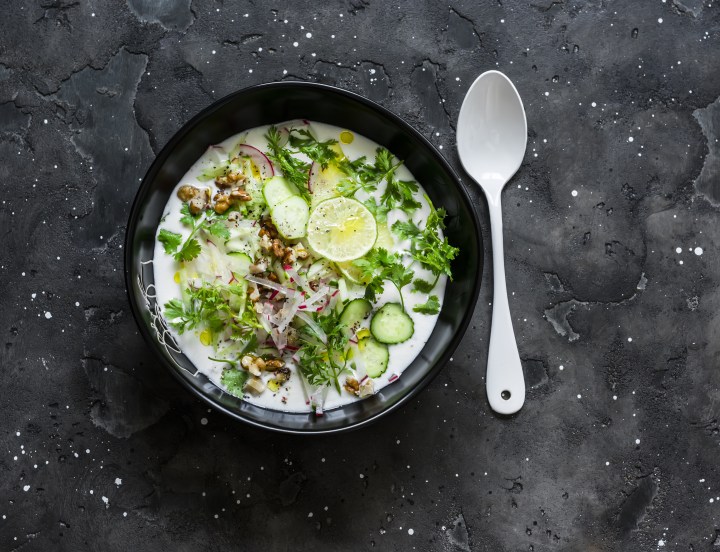
Mediterranean Cucumber Soup with Dill and Walnuts

Mediterranean Cucumber Soup with Dill and Walnuts

Some things are just meant to be together—peanut butter & jelly, socks & shoes, Kurt & Goldie… and cucumbers & dill.

Crisp, cool, and refreshingly simple, cucumbers have been a staple in American kitchens for centuries. Brought to North America by European settlers in the late 16th century, the cucumber is actually native to India and is one of the world’s oldest cultivated crops—around 3,000 years old!

Belonging to the Cucurbitaceae family (hello, watermelon, muskmelon, pumpkin, and squash), cucumbers are 96% water and can be up to 20 degrees cooler on the inside than the outside. Basically, they’re nature’s air conditioning. Plus, a half cup of sliced cucumber has only eight calories—talk about guilt-free crunch.

As a kid, cucumbers meant salad. These days, I’ve used them as crudités, turned them into pickles, slapped them on puffy eyes… but until recently, I’d never made them the main event in a soup.

Here’s the deal: cucumbers aren’t just for spa water. They’re surprisingly versatile. Did you know you can also use cucumbers to:

  • Deter slugs by tossing diced ones in an aluminum pan (the reaction creates a scent pests hate)

  • Help with digestion and constipation, thanks to their water and fiber

  • Fight off tapeworms (they contain erepsin, an enzyme that targets parasites)

  • Cure hangovers—with B vitamins, electrolytes, and natural sugars

  • Reduce cellulite—phytochemicals in cucumbers tighten collagen

  • Promote long, strong hair (they’re packed with silica, calcium, and sulfur)

  • Even clean toddler graffiti—cucumbers can erase crayon marks from walls!

Now let’s talk about cucumber’s BFF: Dill.

More than just a flavorful herb, dill is packed with health benefits. It’s rich in flavonoids, which can help reduce the risk of heart disease and stroke, and it may even lower LDL (“bad”) cholesterol. According to our ever-reliable friend WebMD, dill:

  • Regulates blood sugar (thanks to eugenol)

  • Promotes digestion

  • Strengthens bones

  • Fights infections

  • Even helps remedy insomnia

Add in some heart-healthy walnuts and a touch of spice, and you’ve got yourself something that feels like a magic elixir. This chilled soup has roots in Eastern Europe, similar to the Turkish çorba known as cacık (pronounced “jah-jick”), a yogurt-based dish beloved throughout the Mediterranean.

I tried a few different versions, but this one—with red pepper flakes and a hint of tarragon—was the winner. Creamy, tangy, herby, and just a little spicy.

If you make it, tag me—I want to know what you think! 🥒💚

Pan Seared Tofu Bahn Mi with Herbs de Provence BBQ Sauced

Pan Seared Tofu Bahn Mi with Herbs de Provence BBQ Sauced

Never before have I been so enthralled by a book, especially a cookbook. Alice Toklas’s cookbook is anything but ordinary. It’s a captivating collection of true stories about cooking for friends in Paris, including Thornton Wilder, Picasso, and Matisse, and friends cooking for her and her partner Gertrude Stein, with recipes sprinkled throughout.

Each recipe is a personal narrative, detailing when it was cooked, where, and who she was with when she ate it. The backdrop is set in southern France just before the dark days of Hitler’s occupation.

When urged to leave France for America, Toklas’s partner, Gertrude Stein, responded in a testament to her love for food and the discomfort she was willing to endure. She was quoted as saying,” Well, I don’t know. Moving back would be awfully uncomfortable, and I would be fussy about my food. Let’s not leave.”

So, Toklas and Stein stayed in France, even though Thornton “Thornie” Wilder had procured a safe place for the women in Greenwich Village.
Instead, they left Paris and headed for Bugey near the Swiss border, where they rationed food and cigarettes and made somewhat questionable friendships.

Some have even argued that Stein’s insistence on not leaving France explains her relationship with the Vichy regime, an authoritarian puppet regime that governed the southeast of France and collaborated with the Axis powers, and her unlikely friendship with Marshal Phillipe Pétain.

Perhaps, in a desperate bid for survival, Stein, a Jewish lesbian like Toklas, worked for the regime as a propagandist. No one can say for certain, but they were more than cared for and given everything they needed (ration coupons for meat and butter) to survive the harsh winter months. Toklas even said, ‘The occupation wasn’t so bad,’ they were ‘some of the happiest years of her life.’ She spoke of getting food from some of her friends in the resistance, leading many to believe that the two women did what they had to do to survive.

I make no judgment; I am simply an entertained and fascinated observer and recipe lover. Before Toklas’ cookbook, which richly details the French mentality toward eating and how deeply their beliefs and traditions are observed through food, I had only read Julia Child’s The Art of French Cooking. Her beef bourguignon recipe is the backdrop for my mushroom bourguignon, which is one of my favorites! I remember the first time I made it; the aroma filled my kitchen, and I was transported to the French countryside.  

When I stumbled upon Ms. Toklas’s recipe for Oeufs Fracais Picaba and she cheekily instructed the reader to quote, “Pour the eggs into a saucepan—yes, a saucepan, no, not a frying pan,” it was a moment of pure amusement! Her book was a treasure trove of wit and wisdom, and I eagerly turned the pages.

The book also made me hungry, and no, not for mutton. I craved the rich and savory flavors associated with Cuisine Française, the thick, hardy bread, and the ‘amalgamation’ of flavors she spoke of in her book. The concept of ‘amalgamation’ in French cuisine is about the harmonious blending of different flavors and ingredients to create a unique and delightful taste.

The French were never one for substitutions; they wouldn’t use lamb if they didn’t have mutton for a mutton recipe. They are strict observers of tradition and refuse to substitute or sacrifice an ingredient for necessity or simplicity’s sake.

But let’s be honest—this isn’t 1920s France, and I’m just a hungry soul! So, I decided to whip up a dish inspired by Toklas’s book, possibly making her turn over in her grave.  Starting with a petit French baguette, I marinated mashed avocado in lime juice and salt to create a creamy base (in place of pâté) for my spicy Herbs de Provence BBQ tofu.

A take on a banh mi, a Vietnamese sandwich that originated during the French colonial period in Vietnam and is a fusion of French and Vietnamese culinary traditions, I decided to buck the French tradition of convention and go renegade.

The Herbs de Provence mixed with dijon mustard, garlic, molasses, tomato paste, and red wine vinegar is reminiscent of a Poulet au Vinaigre, but instead of chicken, I used tofu. I topped the sandwich with cucumber marinated in red wine vinegar and salt, petits épinards (baby spinach), and a remoulade, or spicy French mayo. “Twas delicious!

By the way, I’m back on Instagram under @chefsteph_stl and am grateful for the four-month break. Social media and I have never really gotten along, but this time, I’m going to post on my own terms. It will be a mix of all things: food, music, travel, and philosophy!

As always, tag me if you make it.

XO,

Steph

I love you, Alice B. Toklas Fudgy Brownies

I love you, Alice B. Toklas Fudgy Brownies

I love to read as much as I love to write. The eloquence of the written word has consistently captivated and consumed me, but it rarely eluded me—until I read Gertrude Stein. I have a minor in philosophy, and let’s say reading Descartes or Kierkegaard is more straightforward than reading Stein. Like the great treatises, her works require intense examination, patience, reflection, and a willingness to grapple with complex ideas and arguments rather than simply absorbing the traditional narrative form.

Not that there’s anything wrong with the latter. Ms. Stein’s Lost Generation contemporaries wrote some of my favorite books. Hemmingway, Elliot, Fitzgerald, and Steinbeck were gifted writers whose works will undoubtedly stand the test of time. Their writings, each unique in style and content, continue to captivate readers and inspire new generations of writers.

Although some argue Steinbeck’s writing was more grounded in realism and social commentary than the Parisian expatriates’ experimental and modernist styles, Steinbeck’s novel The Red Pony is still one of my favorite books. The Love Song of J. Alfred Prufrock by St. Louis native T.S. Eliot is one of my favorite poems. But, alas, I digress.

While Hemmingway’s writing is direct, Stein’s work is multi-layered and open to interpretation. Like her dear friend Pablo Picasso, who deconstructed and reassembled objects from multiple perspectives, Stein uses simple words and everyday language, arranging them in a way that makes them almost unrecognizable.

As is my habit with art that I admire, I often delve into the artists’ lives to understand their work better. During one of these explorations, I stumbled upon a significant figure in Gertrude Stein’s life, Alice B. Toklas. Perhaps it was Alice who helped me understand Stein best.

Alice was more than just a figure in Stein’s life. She was her confidant, lover, cook, secretary, muse, editor, critic, and general organizer, chiefly living in the shadows (thanks, Wikipedia). Behind every great woman is another great woman. Alice, it turns out, wrote a cookbook and the very first recipe for pot brownies. Yep. While I may be wrong, cannabis makes Stein’s writing style make much more sense.

“Haschich Fudge” was printed in The Alice B. Toklas Cook Book in 1954. Of course, this wasn’t Toklas’s recipe—it was sent to her by a friend, the artist Brion Gysin, who lived in Morocco. (You may not recognize the name, but he’s a literary celebrity in his own right or should be: Gysin invented the cut-up method, which William S. Burroughs made famous.) But that is a story for another time. 

Alice B. Toklas and Gertrude Stein Via: The New Yorker

Publishers left the risqué recipe out of the US publication; the 50s weren’t ready for her recipe or her pot pals. Eventually, in the early 1960s, a second edition, including the recipe, was published for US consumption, and hippie culture crowned their queen.  Hence, the 1968 Peter Sellers movie I Love You, Alice B. Toklas.

I love this movie for so many reasons.  The film’s exploration of racism, culturalism, religion, traditional norms, and how superficial facades of convention fade after having a few brownies is a nostalgic reflection of the 1960s culture.  

Whether it was a traditional family or a group of stoned-out communal hippies, Sellers realized each group had their own expectations.  Are you square, or are you hip?  In the end, it turns out it was all the same thing.

Finally, at the movie’s end, Sellers’ character, Harold Fine, decides that the constraints of each of those two worlds were not a world he was comfortable in. However, once cannabis opened the door in his mind, he realized he didn’t have to settle for the confines of either. So, he seeks to find a third life—one that combines the relevant elements of the previous two existences, sheds the unyielding expectations of everyone, and sets out to find his own path. Like Stein’s work, the movie is fantastic and open to interpretation.

I Love You, Alice B. Toklas (1968) Photo Via: Turner Classic Movies

So, Tolkas’s recipe calls for stoned dates, which made me laugh out loud! Stoned simply means removing the seed (or stone) from the dates. While I recommend chopping and dicing first, feel free to fire one up and blow some smoke their way. The original brownies recipe doesn’t do much in the way of “getting you high,” like the more modern versions using canna-oil. You see, THC needs a fat molecule to dissolve and release from its plant, so we infuse it into oil.

However, overheating this mixture will cause the THC to evaporate, and all your efforts will have been for nothing. So, please repeat after me, I shall not let my oil boil!  I tried to make a recipe that was as close to Toklas’s. It’s raw vegan (okay, mostly raw) and uses either oats or hemp seeds, though I prefer the texture of oats. Before making this recipe, please read the Description and disclaimer in the Notes section!

Enjoy!