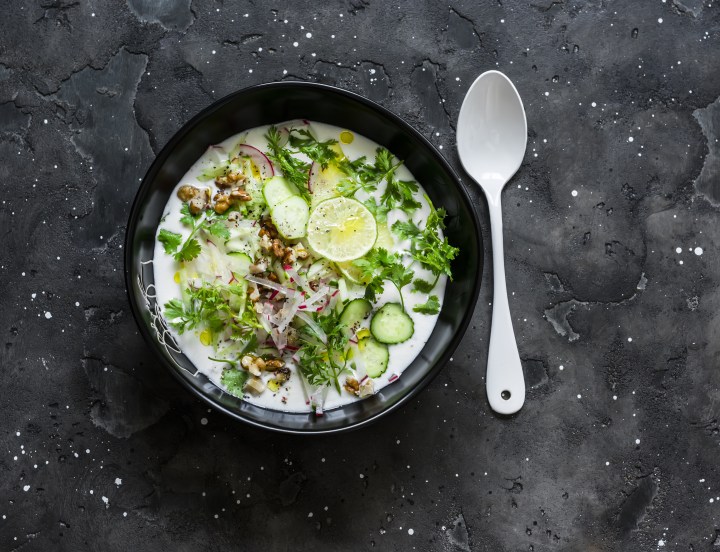
Years ago, I was fortunate enough to spend some time in Newport, Rhode Island, and I fell completely in love with the place. I can’t wait to go back someday. As a foodie, of course, my first mission was to find the very best clam chowder I could. So at every restaurant I visited, I ordered a bowl.
The clear winner was from a restaurant called the Black Pearl. Their chowder had the perfect balance of creaminess, texture, and flavor—something I’ve never forgotten.
Now that I’m vegan, I steer clear of seafood, but my love for clam chowder has never faded. And I don’t think I’m the only one. The most-viewed recipe on my blog, with nearly 7,000 views, is my vegan lobster bisque made with lobster mushrooms. That’s when it occurred to me—it might be time to try my hand at a vegan version of clam chowder.
Part of the reason I love creating plant-based versions of old favorites is because it lets me keep the memories without taking anything from the ocean that gave them to me in the first place.
The sea has always felt like something sacred—wide, mysterious, and alive—and these days I’d rather celebrate its flavors than deplete its creatures. If a bowl of chowder made with mushrooms and a pinch of dulse can capture that same coastal comfort, then to me, that feels like a small, delicious way of giving something back.
This recipe uses oyster mushrooms in place of clams and is seasoned with dulse flakes for that subtle taste of the sea. I promise—you’ll be in chow-dah heaven.
A creamy, coastal-inspired chowder made with tender oyster mushrooms, potatoes, and a silky cashew cream. Comforting, nostalgic, and completely plant-based.
Ingredients
Scale
Chowder
1 yellow onion, diced
2 stalks celery, diced
2 cloves garlic, minced
6 oz oyster mushrooms, small dice
3 small russet potatoes, small dice
Leaves from 10 sprigs fresh thyme
4 cups vegetable stock
2 Tbsp dulse flakes
1 tsp garlic powder
1 tsp salt
1 tsp pepper
1 tsp white miso paste (optional, for depth)
1–2 tsp lemon juice (to finish)
Fresh parsley, chopped (optional garnish)
Cashew Cream
1 cup raw cashews
1 tsp garlic powder
1 tsp onion powder
1 tsp sea salt
Dash white pepper
1 cup water
1 tsp lemon juice or apple cider vinegar
Instructions
1. Make the cashew cream Add cashews, garlic powder, onion powder, salt, white pepper, lemon juice, and water to a high-speed blender. Blend until completely smooth. Set aside.
2. Sauté the mushrooms Warm a Dutch oven over medium heat. Add the diced oyster mushrooms and sauté dry or with a splash of stock until lightly browned, about 5–6 minutes. Add a small splash of tamari or soy sauce (about ½ tsp) and cook 30 seconds more. Remove mushrooms and set aside.
3. Build the base In the same pot, add 2 Tbsp vegetable stock, onions, and celery. Sauté until onions are translucent, about 7–8 minutes. Add garlic and cook until fragrant, about 30 seconds. Season lightly with a pinch of salt.
4. Simmer the chowder Return mushrooms to the pot. Add potatoes, thyme, vegetable stock, dulse flakes, garlic powder, salt, pepper, and miso (if using).
Bring to a boil, then cover and reduce heat to low. Simmer for 15–20 minutes, until potatoes are tender.
5. Thicken naturally(optional but recommended) Mash about ½ cup of the potatoes directly in the pot to create a thicker, chowder-like body.
6. Finish with cream Stir in the cashew cream. Add lemon juice and taste for seasoning. Adjust salt and pepper as needed.
7. Serve Ladle into bowls and top with fresh parsley if desired. Serve with croutons or oyster crackers.
Notes
Chef Steph Tips
For a more traditional New England profile, skip the dill and keep the thyme and parsley.
For extra ocean depth, a tiny pinch of Old Bay works beautifully.
The chowder thickens as it sits—add a splash of stock when reheating.
I watched Eat Drink Man Woman twice because something in me sensed I hadn’t finished receiving it.
The first viewing let the story move through me.
The second revealed how much had been happening quietly — in gesture, rhythm, silence, and what was left unsaid.
It felt like a film that did not reward haste.
It required listening.
That felt appropriate, given both the moment from which the film emerged and the director who made it.
The title itself reaches much further back than the film. Eat Drink Man Woman comes from the Book of Rites, one of the foundational Confucian texts, which names basic human desires not as moral failures, but as natural facts of being human.
The opening of the passage reads: “The things which men greatly desire are comprehended in food and drink and sexual pleasure.”
In this framing, appetite and desire are not problems to be solved or sins to be overcome; they are realities to be understood, ordered, and lived with care. The phrase eat, drink, man, woman emerges from this lineage — not as indulgence, but as acknowledgment.
Ang Lee, whose work also includes Crouching Tiger, Hidden Dragon, Brokeback Mountain, andLife of Pi, has returned again and again to the tension between inner truth and inherited structure — the ways family, culture, gender, and duty shape what can be spoken or lived.
What remains unexpressed in his films does not disappear; it migrates. It moves into the body, into gesture, into repetition, into food. Eat Drink Man Woman speaks that language fluently.
Released in the early 1990s, during a period of profound cultural transition in Taiwan, the film arrives at a moment when women were entering the workforce in unprecedented numbers, gaining financial independence and real authority over their futures.
Marriage was no longer inevitable.
Choice had entered the conversation.
And yet tradition had not vanished. It lingered — shaping expectation, silence, and obligation — even as new possibilities pressed against it. The film lives inside that overlap.
Confucian hierarchy remains woven through family meals and filial duty.
Buddhist sensibilities surface in patience, impermanence, and the understanding that attachment causes suffering.
Alongside them, Christian ideas quietly emerge — not as doctrine, but as posture: confession, truth-telling, beginning again.
What we witness is not replacement, but coexistence. A family — and a culture — learning how to hold more than one truth at the same time.
What Eat Drink Man Woman understands, and patiently unfolds, is that love never actually disappears.
It changes form.
When it cannot be spoken, it is cooked.
When it cannot be claimed, it is carried through ritual, lineage, and care.
Love as Practice
The film opens not with romance or conflict, but with Master Chef Chu’s hands at work. A revered chef in Taipei, we watch technique forged over decades—knives moving with certainty, textures judged by feel, timing held in the body rather than the clock.
The skills of a chef are not mechanical; they are fluid and intuitive, shaped by repetition until thought disappears.
Chu does not measure so much as listen—to heat, to resistance, to the moment when something is ready to become something else. His restraint is not limitation but mastery: knowing precisely when not to intervene.
Fish are scaled and filleted, dough is kneaded, broths are tended; the camera lingers on hands, steam, and silence as cooking reveals itself not as preparation but as art.
When the elaborate Sunday meal finally reaches the table, its abundance is met with deliberateness rather than conversation—the food speaking where the family does not.
This is the first love the film offers us: Sunday dinner, devotion to craft. Before family, before romance, before disappointment or longing, there is mastery—earned through repetition, reserve, and care.
Chu’s precision is aesthetic as much as technical. Each dish is composed the way an artist approaches canvas and brush.
Balance is intentional.
Color is considered.
Texture, temperature, and timing are arranged with the same deliberation as line and negative space.
Nothing is casual.
Nothing is improvised.
The plate becomes a finished work—complete, exacting, and self-contained.
Cooking is not a backdrop to Eat Drink Man Woman; it is its original language. Love enters the film first as practice—as discipline, as art rendered through the body.
Like a monk who fasts while feeding others, Master Chef Chu prepares elaborate meals with extraordinary precision, yet cannot taste them himself. Though the cause is never addressed directly in the film, symbolically Chu’s loss of taste reflects a deeper emotional condition.
He has lived a life shaped by discipline, temperance, and self-erasure—cooking exquisitely for others while denying himself pleasure, expression, and vulnerability.
Over time, devotion hardens into distance.
Feeling, like tasting, atrophies when it is never received back. His tastelessness mirrors his emotional silence: he can produce beauty, abundance, and nourishment, yet cannot receive them.
Pleasure has been externalized.
Sensation has been replaced by control.
His love is expressed not through language but through labor, not through confession but through devotion.
What he offers is presence, not pleasure.
There is something distinctly Buddhist in this posture: self-erasure in service, mastery without indulgence, repetition as devotion.
This understanding of love extends beyond family and romance and is most clearly embodied in Chu’s relationship with Uncle Wen.
The two men have worked side by side in the same kitchen for more than thirty years, moving together through rhythm and muscle memory rather than conversation.
Their intimacy is procedural, wordless, earned over time.
Love, here, is not spoken.
It is practiced.
Love as Devotion
The film is precise about where urgency appears and where meaning settles.
Master Chu is at home when the call comes to help his longtime friend, Chef Wen, at the restaurant. The two men are like brothers cut from the same cloth, having grown old together in the kitchen, their lives shaped by shared labor and quiet reliance.
Something has gone wrong: the soup for the Governor’s son’s wedding has failed. Chu arrives without urgency or display, restores what has been disrupted, and saves the dish through skill rather than spectacle.
Only after the work is finished do the two men finally sit together.
They share a drink. Wen, half-teasing and wholly sincere, compares Chu to Ludwig van Beethoven—a master whose genius is disciplined, uncompromising, and forged through relentless devotion rather than charm.
The compliment is not grand; it is intimate, offered between equals who recognize what the other has endured.
It is there—after labor, after urgency—that the words are spoken aloud:
Eat. Drink. Man. Woman.
The line lands softly, almost in passing.
Not as a title. Not as a declaration. As recognition.
Life reduced to its essentials. Meaning does not arrive during the rush; it comes afterward, when there is room to sit.
After the Rush
Later, back in the kitchen, Chef Wen tastes a soup Chu has made. At first, the exchange reads as familiar banter—heat, spice, teasing between men who have shared decades of work. Then Wen collapses.
By the time Chu’s daughter, Jia-Chien, reaches the hospital, the crisis has already shifted into aftermath.
Fear remains, but softened.
Wen is fine.
When Jia-Chien addresses him, she calls him Uncle Wen. In Taiwanese culture, kinship is not limited to blood; older family friends—those woven into daily life through care and continuity—are often called uncle, a title that signals closeness rather than lineage.
Jia-Chien is still visibly shaken, but Chef Wen laughs it off as indigestion from eating her father’s food.
There is relief.
Familiar joking.
Mortality has brushed past, just enough to loosen the usual hierarchy.
It is in this softened space that Jia-Chien speaks. For the first time, she admits that she wanted to become a chef. Her father dismisses it immediately—education mattered more, he insists.
She bristles. No one ever asked me what I wanted.
The line presses against an older order, one in which daughters were shaped by duty and rarely consulted about desire. It is Wen who answers her, gently and without authority. He tells her she would have made a fine chef.
The sentence is small.
The recognition is not.
It is the first time her talent is named aloud by someone not threatened by it.
He was one of the few voices willing to see her clearly without trying to shape her future.
Later, when Jia-Chien returns to the hospital, she is told that Wen has already left. He was not discharged; he simply went. The absence lands quietly, but its meaning lingers. His role was never formal, yet his presence carried weight.
The next time we see him, he is back in the restaurant, among his friends. He walks through the familiar space, takes a seat, and dies there—not in a hospital room, but in the place where his life had been practiced and shared.
Only then does the meaning settle.
His leaving was not denial. It was belonging.
In Buddhist terms, it is a right leaving—choosing the conditions of one’s final moments with awareness rather than resistance.
Love, here, is not sentimental.
It is fidelity.
The Daughters and the Inherited Script
At home, the phrase eat, drink, man, woman becomes an inherited framework — received differently by each daughter.
While the adults in Eat Drink Man Woman speak in philosophy, the daughters live love in practice — each discovering a different way it can become survivable, inhabitable, and real.
Jia-Jen, the eldest, is a chemistry teacher — resticent, cautious, almost deliberately plain. She does not wear makeup. She keeps her hair pulled back. Her clothing is modest, functional, designed not to draw attention. Having been hurt earlier in life, she moves through the world as though visibility itself were risky.
When anonymous love notes begin to appear, her first assumption is not desire but ridicule. She believes she is being mocked. That someone is playing a joke on her for daring to be noticed at all.
Love, to her, feels less like invitation than exposure.
It is in this state that she goes to confront the students at her school — and in that moment, something striking occurs.
She arrives transformed.
Her hair is styled.
She wears makeup.
She is dressed in a vivid red dress that refuses modesty or apology.
The shift is not flirtation. It is declaration.
The symbolism is unmistakable. She is not asking to be chosen; she is asserting that choice has always existed. The message beneath the confrontation is clear: I could be this if I wanted to be. The years of containment were not incapacity — they were protection.
Jia-Chien, the middle daughter, lives at the intersection of competence and restraint. She is an executive — capable, disciplined, respected — yet this life was not the one she originally wanted.
As a young woman, she longed to be a chef, to live inside the kitchen and the language of food. Her father shut that path down firmly, insisting she pursue education instead. What appears as success in adulthood still carries the residue of that early redirection.
In love, Jia-Chien remains unsettled. She drifts between relationships without fully committing, allowing closeness while keeping herself just beyond being claimed.
Most telling is her involvement with a man who insists he does not want to be tied down.
She accepts the terms — not because they satisfy her, but because they allow her to remain contained.
The arrangement feels honest, even safe, until she quietly learns that he has, in fact, chosen someone else to marry.
The rupture is internal and devastating.
There is no confrontation, no spectacle — only the confirmation of an old pattern: she has learned how to love without asking for more than is offered.
We see this most clearly in the kitchen, when Jia-Chien cooks dinner for him shortly after being offered a promotion at work. Professionally, she is ascending — recognized, expanded, rewarded. Yet the scene does not linger on her achievement.
Instead, it turns toward feeding him. Authority in the public world does not translate into claim or assertion in the private one. Intimacy remains the place where she offers rather than asks, balances rather than risks.
When Jia-Chien explains that she has prepared the duck two ways — one hot, one cold — she describes it simply. “Cooking is about balance,” she says. “Hot and cold have to be in harmony.”
When her boyfriend names it — yin and yang — she only nods.
Yes.
She frames it as culinary philosophy: cooling and warming, austerity and intensity held in careful proportion.
But what she is really describing is how she has learned to love.
The hot dish carries effort, care, and desire. The cold dish holds distance, control, and self-containment. Together, they allow her to remain present without being fully exposed.
Love, here, is not refused — it is portioned. Balanced carefully enough that nothing overwhelms, nothing demands too much.
This is not a failure of feeling, but an act of self-preservation. Jia-Chien does not lack depth or devotion; she has learned to regulate them precisely. Balance becomes a way of staying intact when full surrender feels too costly.
For now, her story remains suspended — between heat and cold, mastery and longing, offering and withholding — unresolved, but deeply alive.
Cooking is where she is most alive, most honest, most herself. Love, for Jia-Chien, does not culminate in a man but in vocation: in choosing a life shaped by devotion and being recognized within it.
Her arc does not resolve through romance, but through mutual recognition — finally being met by her father as an equal who speaks the same language of care.
The youngest, Jia-Ning, comes to love through ease rather than struggle. She falls for a man who is initially dating her friend — a woman who keeps him waiting, keeps him longing, keeps him suspended in emotional uncertainty.
Jia-Ning offers something radically different.
With her, he can speak freely, be himself, laugh, and rest. Their pivotal conversation is not about romance but about what it feels like to love someone — to be unguarded, to talk as you are, to exist without performance.
Love, for Jia-Ning, is not drama or longing. It is immediacy.
Honesty.
Shared presence.
Together, the daughters quietly expand the meaning of eat, drink, man, woman. Love is not a single destination. It is lived — as permission, as vocation, as home.
(Sidenote: In Taiwanese naming conventions, the family name comes first — Chu — followed by the given name. All three daughters share the generational name “Jia,” signaling lineage before individuality. Identity precedes choice.)
Mrs. Liang and the Language of Release
Into this household enters Mrs. Liang with a clear intention: to make Master Chef Chu her husband. But the self she brings with her is not an offering; it is an approximation.
Rather than attuning to who Chu actually is, she presents what she imagines might be desirable—performing sophistication, provocation, and worldliness.
She smokes.
She speaks in sharp aphorisms.
She carries herself as though sentiment were a weakness.
She presents herself as unencumbered by sentiment.
Yet she misses every cue he gives her.
The misattunement is constant and revealing. She smokes cigarettes beside him while he coughs, never pausing to notice his body’s response.
She puts her cigarette out not in an ashtray, but in the food he has prepared — a gesture so casually invasive it borders on desecration.
What he has made with care and precision becomes the surface onto which she extinguishes her impulse.
It is not intimacy; it is intrusion.
Symbolically, the moment says everything.
She wants closeness, but she cannot recognize the language of his devotion.
She wants to be desired, but she has no capacity for attunement.
Rather than meeting him where he lives — in stillness, ritual, sensory precision — she imposes herself onto his world, confusing presence with pressure.
Her contradictions stem from this same lack of integration. She speaks of detachment while craving attachment, dismisses children while interrogating the daughters about boyfriends, derides marriage while angling for proximity.
These are not complexities held in tension; they are fragments colliding without regulation.
Mrs. Liang does not metabolize experience — she reacts to it. Her nervous system leads, her philosophy follows.
In this way, she becomes a study in unintegrated desire: a woman who has language for suffering but no capacity to stay present inside relationship.
She wants to be what she thinks he wants, rather than perceiving who he is.
And in doing so, she illustrates one of the film’s sharpest truths — that desire without attunement does not create intimacy.
It creates noise.
Love, Pain, and Integration
Watching these stories unfold, I realized the film was no longer asking me to interpret love. It was asking me to recognize it.
I thought of Sean, my first love. He carried a vision of adulthood shaped by youth, culture, and tradition—a future that was orderly and legible, oriented toward stability and the familiar promises of the American dream. Love, as he understood it, was meant to secure that future, not complicate it.
We did not yet have the language to understand one another. I was not bound by inherited expectations; I set my own. I lived by a different set of rules, saw the world less restrictively, trusted openness more than prescription.
I believed, then, that love could resolve difference if given enough room—that it could soften even the most rigid structures. What I did not yet understand was that love cannot always translate between worlds shaped by different grammars.
One night after work, Sean came to see me. He drove all the way from St. Louis to Columbia. We spent two days together—quiet, ordinary, intimate without declaration. And then I never heard from him again.
That was it.
It was over. No explanation. No late-night apologies. No attempt to soften the leaving.
Just gone.
Later, I learned he had already been in a relationship with his neighbor for much of that time—nearly six months. The knowledge did not arrive as betrayal so much as clarification.
The disappearance was not confusion; it was a choice made elsewhere, in a life already moving in a direction I was never meant to inhabit.
That kind of ending does something to a person. It teaches the wrong lesson with absolute clarity: that love disappears without warning, that closeness invites abandonment, that the safest way to survive attachment is to limit it.
Over time, love begins to feel less like shelter and more like risk—something to be approached carefully, or held at a distance.
Between the first viewing of the film and the second, a dream arrived—quietly—about him. I was at his mother’s house, a place dense with memory and lineage. She led me to his room gently, almost ceremonially.
Sean was thin, very sick. When I reached for him, even the slightest pressure caused him pain. I pulled back immediately. The message was unmistakable: love, even when tender, could not touch him without hurting him. Love did not heal. It witnessed.
Seen through the lens of the tarot spread I later pulled, the dream revealed itself not as loss, but as integration. Love and pain had long been bound together there, but not by necessity. The pain did not arise from love; it predated it.
In sitting with him—without fixing, without holding, without trying to take the suffering away—something finally settled. What my subconscious was releasing was an old equation it had carried for years: that love must always arrive through pain.
Last May, my heart broke once again—I received a phone call from my best friend telling me that Sean had died by suicide.
My heart broke not only because he was gone, but because no one had seen it coming. By all outward accounts, he was fine. He was working. He was partnered. He was building a life that appeared stable and legible.
Whatever pain he carried had remained carefully contained, invisible even to those closest to him.
There is one more detail I have never known what to do with. In the months before his death, someone reached out to me online under a benign, forgettable name.
He loved to cook.
He asked practical questions—about ingredients, about places I like to visit, about how I lived.
Nothing dramatic.
Nothing confessional.
It felt domestic.
Gentle.
Familiar.
Shortly before Sean died, the messages stopped.
Some connections do not announce themselves clearly. They arrive sideways—through food, curiosity, proximity—and sometimes leave the same way.
Without explanation. Without resolution.
What remained was not closure, but recognition.
And it was only then that the film came back into focus—not as a story about love lost or love withheld, but as a meditation on what love requires when it can no longer act.
The deliberateness it asks for.
The listening it demands.
The courage to remain present without intrusion.
What the film also makes room for—quietly, without defense—is the idea that tradition is not the final authority on love. That inherited expectations, however well-intentioned, are not the same thing as truth.
Love does not always arrive in approved forms. It does not wait for consensus. Sometimes it appears where it is least expected, asking not for permission but for courage.
This was the lesson I could not yet see with Sean. We were both living inside visions shaped by tradition—his more tightly bound than mine—but neither of us yet knew how to step outside them together.
Love came anyway.
And when it left, it left behind a belief that would take years to loosen: that breaking from expectation leads only to loss.
The film gently argues otherwise.
In the world of the film, as in life, love does not always arrive as comfort. Sometimes, it arrives as heartache.
And sometimes, it arrives asking to be chosen—despite tradition, despite appearances, despite what others think should make sense.
Balance at the Table
At the final dinner, Master Chef Chu, after throwing back a few glasses of sorghum liquor, announces that he has something he needs to tell everyone. The daughters do not speak. The table stills. What follows is not interruption or protest, but attention.
He tells them first that he is selling the house. The declaration lands not as logistics, but as rupture. The home that has held ritual, hierarchy, and inheritance will no longer anchor the family. What has been preserved for decades is being released.
And when he finally speaks again, it is not to reclaim control, but to relinquish it. The reason he’s selling the house is because he’s getting married.
The things we viewers have witnessed, a cardiologist visit. The herbal tonic prepared not out of vanity, but out of longing—all of it begins to align. Chu has been readying himself to love again, to risk desire with a body disciplined by decades of renunciation.
Seen this way, Chu was never simply guarding ritual or clinging to authority.
He was watching.
Waiting.
Preparing.
His marriage is not to Mrs. Liang, with her loud philosophies and invasive certainty, but to her daughter, Jin-Rong—a woman quieter in temperament, steadier in presence, attentive in ways her mother never was. The choice reframes everything that came before.
Chaos follows. Food spills. Control loosens.
The household unravels—not as failure, but as release. In that moment, the patriarch steps out of mastery and into appetite, and the family’s long-held balance finally tips, making room for a different kind of order.
Jin-Rong is younger, reserved, and almost self-effacing. She arrives not with philosophy or performance, but with presence. She has a small daughter whom Chu loves without hesitation, and whom she trusts him to love.
What becomes clear, without speech or insistence, is that Jin-Rong does not want what she imagines life with him could provide.
She does not project onto him or reshape herself to be desirable.
She sees him—not the master chef, not the patriarch, not the symbol—but the man himself.
And he loves her in return, not as a solution to loneliness or continuity, but as a mutual recognition.
In choosing her, Chu chooses attunement over provocation, integration over performance, and love that is practiced quietly rather than demanded loudly.
The film does not reward noise. It rewards recognition.
And then the film ends where it began.
Learning to Taste Again
When Jia-Chien buys the family home, the gesture is quiet, almost easy to miss — and that is precisely its power. This is not nostalgia, nor retreat. It is not a daughter clinging to the past after the patriarch leaves.
It is inheritance transformed into choice.
For the first time, the house does not belong to authority or obligation; it belongs to someone who has consciously decided to remain.
Throughout the film, the house has functioned as an extension of Master Chu’s authority — a place governed by ritual, silence, and mastery. Jia-Chien once refused to cook in its kitchen, saying she would be stealing her father’s thunder.
Her talent was too close to his, too threatening in a world where kitchens were not meant to belong to daughters. Buying the house does not reverse that tension; it resolves it.
She does not take his place.
She takes responsibility on her own terms.
When Chu returns to the house at the end of the film, something essential has shifted. It is no longer his domain. Jia-Chien is in the kitchen, preparing food for him. The roles have changed without announcement.
They eat, and almost instinctively fall into critique. He tells her she has used too much ginger.
She fires back that he has always been too restrained.
The exchange is familiar — the language they have always shared.
And then, unexpectedly,
Chu stops.
He tastes again.
For the first time in years, he says he can actually taste the food.
The moment is revelatory for both of them.
For Chu, it suggests that mastery — repetition, control, perfection — had dulled sensation itself. He had been cooking endlessly, but no longer tasting.
Eating food prepared by someone else, especially by his daughter, returns him to the body, to appetite, to pleasure.
For Jia-Chien, it is confirmation that inheritance does not require imitation.
She has not surpassed him or replaced him.
She has allowed him to experience something new.
Buying the house makes this possible. It turns legacy into stewardship rather than dominance. The space is preserved, but softened.
Tradition remains, but it is no longer enforced through hierarchy. Jia-Chien becomes the holder of continuity without becoming its warden — capable of remaining without being trapped, of caring without controlling.
This is the same balance she once described with the duck: hot and cold, intensity and measuredness, held in proportion.
Each daughter resolves inheritance differently.
Jia-Jen chooses late love.
Jia-Ning chooses motion.
Jia-Chien chooses ground. Her decision to buy the house is not about settling down; it is about holding space.
And in that final act of tasting — ginger sharp on the tongue, restraint loosened just enough — the film closes not with mastery, but with reciprocity.
Authority gives way to relationship.
Silence gives way to recognition.
And for the first time, everyone can finally taste what has been there all along.
He takes her hands.
“Daughter.”
“Father.”
It is quiet.
It is everything.
Why This Soup
Earlier, Jia-Chien describes cooking duck two ways — one hot, one cold. Yin and yang. Balance, not resolution.
That is why I watched the film twice.
Some truths do not announce themselves. They reveal themselves only when we slow down enough to taste them.
I did not choose miso soup because it belongs neatly to the film’s geography. I chose it because it belongs to its philosophy.
Hot broth. Cold tofu.
Balance is not imposed.
It is honored.
In the Book of Rites, desire is not condemned — it is acknowledged, then held with care. Food and love are not problems to be solved, but realities to be tended.
And that, finally, is what love has to do with it.
The broth is warm, savory, and deeply grounding — miso softened by ginger and a hint of sesame, not aggressive, not loud. It doesn’t announce itself. It settles. Into that warmth, cold silken tofu is added gently, its texture almost custard-like, barely holding together. The contrast is immediate but not jarring: heat meeting cool, firmness yielding to softness. Each spoonful shifts as you eat it — first comforting, then clarifying, then steady.
What makes the soup work is not complexity, but restraint. The tofu doesn’t try to become the broth, and the broth doesn’t overpower the tofu. They remain distinct, in conversation rather than competition. The result is something calming and nourishing, a dish that asks you to slow down and notice — the temperature, the texture, the way balance is created not by sameness, but by contrast held with care.
It is the kind of soup that doesn’t fix anything. It simply sits with you — warm, steady, enough
Ingredients
Scale
4 cups vegetable stock or water
1 strip kombu
2–3 tablespoons white or yellow miso
1 teaspoon grated ginger
1 teaspoon toasted sesame oil
8 ounces silken tofu, kept cold, cut into cubes
Scallions, sliced on a steep bias
Instructions
Warm the stock gently with the kombu.
Remove the kombu before simmering.
Lower the heat and dissolve the miso in a ladle of broth, then stir it back in.
Add ginger and sesame oil. Taste quietly.
Remove from heat and gently add the cold tofu.
Serve immediately.
The heat softens. The cold steadies. Neither dominates. Nothing disappears.
Notes
Chef’s Note
This soup is less about technique and more about timing. Resist the urge to overwork it. Miso should never boil, and silken tofu should never be stirred aggressively — both lose their integrity when pushed. Let the broth be warm and settled before introducing the tofu, and allow the contrast to remain. The cold tofu is not meant to disappear; it’s meant to temper the heat.
Taste quietly. Adjust gently. This is a dish that rewards patience, not precision.
Serve it when you need grounding rather than spectacle — when what’s required is balance, not brilliance.
Over Thanksgiving, I watched Memoirs of a Geisha—a film my girls hadn’t seen, one my mom recommended, and one I hadn’t revisited since it first came out. You never quite know how one thing leads to another.
Watching it again, I noticed how differently it asks to be seen. Not consumed, but observed. It trains the eye.
Silk. Choreography. Ritual. Discipline. Years of repetition hidden behind movements that appear effortless. Identity shaped not by declaration, but by endurance. Beauty that costs something.
Silence teaches. Seasons mirror inner change. Nothing is accidental—color, posture, timing, even stillness carries intention. Becoming is not about being seen, but about being shaped.
Anchoring the film is Ken Watanabe—steady, watchful, restrained. Authority without spectacle. Recognition without excess. Watching him again, I realized how deeply that presence had stayed with me—not just as a character, but as a way of being. A quiet mastery that doesn’t announce itself, but is immediately felt.
And as attention tends to do when it’s allowed to wander, it didn’t stop there. After the film ended, I looked up the cast and immediately recognized Michelle Yeoh from Wicked. That small recognition opened another door.
Almost inevitably, it led me to Tampopo.
And that’s where everything else began to gather.
Tampopo Centers on a Woman Who Is Becoming
At first glance, the two films couldn’t seem more different. One is silk and ceremony. The other is broth and steam. One is restrained and formal; the other playful, chaotic, absurd. And yet beneath the surface, they are speaking the same language.
Both understand that mastery is not chosen — it is survived into. Identity does not arrive through affirmation or confidence, but through repetition, humility, attention, and care.
In Tampopo, Tampopo—whose name means dandelion—is a single mother running a struggling ramen shop. She is earnest, overwhelmed, and keenly aware of her own inadequacy. Not ashamed of it. Just honest about how far she has to go.
She doesn’t want comfort or shortcuts. She wants mastery.
When she meets Gorō, a stoic truck driver with a discerning palate (played by Ken Watanabe), she does something radical in its simplicity: she asks for help. She offers to pay him to teach her how to make truly great ramen.
What follows is not instant success, but apprenticeship. Gorō becomes her anchor and protector, but the work quickly expands into community.
A self-appointed ramen sensei teaches discipline and tradition. Truckers offer blunt feedback. A contractor from a bar fight provides strength and loyalty.
Each man contributes something different—technique, critique, labor, lineage—but none of them replace her effort. Tampopo trains her body, her palate, her stamina.
She fails publicly. She practices relentlessly. She learns that ramen is not just flavor, but structure, timing, heat, and care.
This is not a story about transformation through talent, romance, or luck. It is a story about endurance. Tampopo does not become herself alone—and she does not become herself accidentally.
She becomes through repetition. Through humility. Through the willingness to be seen while learning.
By the time her ramen is finally judged, the victory is quiet and unmistakable: the bowls are emptied. The work holds.
She has become what she set out to be—not because she imagined it, but because she trained for it.
Tampopo doesn’t explain itself. It invites pursuit.
The Meaning Lives in the Pause
What struck me immediately — and what feels distinctly Japanese in its storytelling — is how punctuated Tampopo is. It moves in deliberate beats rather than smooth arcs. Scenes arrive, land, and end cleanly — sometimes abruptly — like brushstrokes lifted from the page.
There is space between moments. Silence after humor. Stillness after intensity. Nothing is rushed toward resolution.
This punctuation isn’t accidental; it’s cultural. Japanese storytelling often trusts the pause as much as the action, the cut as much as the continuity. Meaning is allowed to crystallize in the gaps.
The viewer isn’t carried forward by momentum so much as invited to stop, to notice, to sit with what has just occurred.
What stayed with me this time was how deeply metaphor is woven into that sensibility. So many Japanese films speak indirectly, asking you inward rather than explaining themselves outright. They trust that if you stay present long enough, meaning will surface on its own.
That rhythm feels rooted in Buddhist thought — reflection over reaction, impermanence over possession, attention as a form of devotion. Gesture carries weight. What is withheld matters as much as what is shown.
Each vignette stands on its own, yet accumulates power through repetition and contrast. The film doesn’t spoon-feed emotion; it places it carefully and steps back. And in doing so, it mirrors everything else it is teaching: attention over excess, intention over momentum, presence over performance.
Why Ramen Matters
To understand why the opening scene in Tampopo feels almost ceremonial, you have to understand what ramen represents in Japanese culture. Ramen is not just food. It is craft, labor, humility, and relationship—contained in a single bowl.
It is everyday food, but never casual. Ramen lives at the intersection of accessibility and mastery. Anyone can eat it. Not everyone can make it well.
And making it well is not about luxury. It is about attention. Broth developed over hours. Noodles chosen for texture and bite. Toppings prepared separately, then assembled with care. Balance matters more than excess. Harmony matters more than spectacle.
Ramen is also deeply democratic. Salarymen eat it after long days. Students eat it late at night. Chefs devote their lives to perfecting it—often one style, one broth, one expression. Entire reputations rest on whether a single bowl can be made the same way, every day, without shortcuts.
This is why ramen carries reverence. Not because it is rare, but because it demands integrity.
So when the old man teaches the younger man how to eat—telling him to look first, inhale the aroma, apologize to the pork, sip the broth before the noodles—he is not being theatrical. He is initiating him into relationship.
He is saying: this bowl contains someone’s labor, attention, and life energy. To rush it is to miss it. To consume without awareness is to flatten it.
When he says “see you again” to the pork, the line lands playfully—but it carries a Buddhist truth. Nothing truly ends. Effort circulates. Nourishment returns in another form. Hunger will return. Attention will be required again.
The younger man laughs because he does not yet understand that ramen, here, is a teacher.
This is why the rest of the film unfolds as it does. People are judged not by what they eat, but by how. Mastery is shown through repetition rather than brilliance. Garnish matters. Finishing the bowl is not greed, but gratitude.
Ramen in Tampopo is not elevated into fine dining—it is honored as daily devotion. And that distinction matters. Because the film’s deeper message is Buddhist at its core: enlightenment does not live only in temples or rituals. It lives in kitchens. In work done well. In care repeated without applause.
They are eating ramen. He is practicing reverence.
What they miss—and what the film keeps teaching—is this: nothing is taken without consequence, nothing truly disappears. The pork becomes warmth, energy, movement. The apology is not superstition; it is awareness.
The men who laugh are not cruel. They are simply unawake.
They are eating. He is communing.
And that distinction becomes one of the film’s central truths.
What the old man actually teaches
1. Attention is the first act of respect He tells him to look at the bowl, admire it, inhale the aroma, acknowledge each element before touching it. This is a lesson in presence. If you rush past what nourishes you, you rush past life itself.
2. Gratitude must precede pleasure The apology to the pork, the reverence for the broth — these come before eating. In Buddhist thought, desire without awareness is suffering. Pleasure rooted in gratitude becomes communion.
3. Mastery is humility, not dominance The younger men treat food as something to conquer, consume, rate. The old man treats it as something to meet.
That difference is the difference between knowledge and wisdom.
Why the other men don’t get it
They laugh because they are still operating from:
efficiency
convenience
ego
entitlement
They think food exists for them.
The old man understands that he exists because of it.
That’s enlightenment — not robes or sermons, but the quiet knowing that:
Life feeds life, and nothing should be taken unconsciously.
The deeper, unspoken lesson
The ramen becomes a koan.
If you can’t slow down for a bowl of noodles, you will miss love, grief, beauty, death, and devotion too.
The old man already knows this. The others are still hungry and don’t know why.
He was not teaching them how to eat ramen; he was teaching them how to stay awake while being fed.
Endurance as a Form of Love
The actress is Nobuko Miyamoto, and her becoming is not accidental. In Tampopo, she isn’t playing a fantasy of a chef — she’s playing a becoming. Curious, awkward, determined, exhausted, joyful. The sweetness of her performance is earned, not cute. It is humility in motion.
She is becoming, not performing.
Tampopo is not introduced as naturally gifted or assured. She is earnest, visibly unsure, still learning where her body belongs. Her hands hover. Her posture betrays effort. Her body doesn’t yet know where to rest.
Miyamoto plays her with exposed sincerity — someone willing to be seen trying, failing, asking, learning. What makes the performance extraordinary is that it is physical before it is intellectual. You can see the learning happen in her shoulders, in her stance behind the counter, in the way she watches people eat.
Early on, she moves like someone apologizing for taking up space. By the end, she occupies the kitchen with quiet authority — not louder, not flashier, just settled.
She embodies:
humility without weakness
persistence without bravado
femininity without ornament
Her Tampopo is neither ingénue nor master. She is the apprentice in real time. And because of that, she becomes a stand-in for anyone who has learned through repetition, embarrassment, and endurance rather than innate confidence.
By the final scenes, when she wears the chef’s hat and stands fully integrated in her shop, the transformation feels earned because it is subtle. Miyamoto never signals triumph. She lets it arrive in stillness — in the way Tampopo watches, waits, and no longer needs to ask.
She doesn’t conquer the world. She learns how to belong in it.
The film’s insistence that good food requires endurance is one of the most honest depictions of kitchen life ever put on screen. It tells the truth chefs know in their bones:
You need physical strength. You need stamina. You need repetition until the body knows before the mind does. You need muscle memory, not inspiration.
Cooking is not just art. It is labor. Training. Load-bearing devotion.
That truth landed for me when I thought about lifting fifty-pound boxes at Gateway — not as metaphor, but as fact. Heavy produce. Hot sheet pans. Full stock pots, sloshing and awkward to carry. Wrists steady. Stance grounded. Timing exact.
At the time, it was just the work. Necessary. Relentless. But in hindsight, I see what it was doing. It was building capacity — real strength in forearms and shoulders, balance and endurance, the steadiness that keeps food safe and people fed.
Tampopo doesn’t romanticize this away. It honors it. It says plainly: devotion requires capacity.
You don’t get to offer nourishment unless your body can hold it. And so the work trains you — rep by rep, service by service — until strength stops being something you think about and becomes something you are.
That’s why the film resonates so deeply for me. Because I live that truth.
The enlightenment in Tampopo does not descend from above. It rises from the ground up — through sore feet, burned forearms, aching backs, repetition, humility, and care. The body learns first. The mind follows later.
Awakening, the film insists, is not delicate.
It is muscular.
It asks something of the body.
And only when the body is willing to carry the weight does the offering become true.
Nourishment as the Final Act
In the middle of the film, a brief vignette becomes one of its darkest mirrors. The moment with the dying woman is unmistakable in its gravity. She is at the end of her life—barely able to stand, her body already receding—yet her husband insists she rise and cook.
Not to nourish her, but to preserve the illusion of normalcy for himself.
Food, which everywhere else in Tampopo signifies reverence, care, and relationship, is inverted here. It becomes an instrument of denial. An insistence that nothing has changed. A refusal to witness her leaving. In this scene, nourishment is no longer love—it is erasure.
As she prepares the meal, he tells her that cooking will make her better.
She sways at the stove, one hand braced against the counter, the other trembling as it reaches for the pot. The room smells of rice and steam and something familiar enough to pretend this is an ordinary night. Her breath is shallow. Every movement costs her.
He sits at the table, waiting.
“Just like always,” he says, not looking at her—as if routine might hold her upright, as if the meal, completed, could seal the cracks already spreading through her body.
She cooks because that is what she has always done. Because standing here gives him something to believe in. Because if the food arrives, he doesn’t have to ask the question hovering between them.
When the bowl is set down, her hands linger on the rim for a moment too long. Then she folds—quietly, almost politely—as if slipping out of the room rather than leaving the world.
The food is still warm.
He eats.
He reframes her labor as healing, as duty, as something that might save her—when in truth, it only allows him to avoid what is already happening. When the family eats, he calls her “mom,” collapsing her identity into function: caregiver, nourisher, source. There is no space for her as a dying person with her own needs.
And when she finally collapses and dies, he keeps eating. Faster. More urgently. As if consumption itself might outrun grief. He refuses to stop, because to stop would be to acknowledge her death.
The symbolism is merciless. Appetite without presence becomes violence. Nourishment demanded instead of offered becomes erasure. Where Tampopo so often shows food as communion, this scene reveals its inverse: eating as a way of refusing to see what is gone.
It is one of the film’s hardest lessons—and one of its most honest.
That scene didn’t just disturb me — it stayed with me. What bothered me most wasn’t only that she died after cooking for her family, but how familiar the logic felt. The belief that if a woman just keeps giving, keeps feeding, keeps showing up, then everything will be okay. That her service is proof of love. That her exhaustion is irrelevant as long as the people around her are being sustained.
What landed hardest was the realization that no one stopped her. No one said, you don’t have to do this. No one asked what she needed. Her worth existed entirely in what she provided, not in her presence, her limits, or her life. And when she collapsed, the eating continued — faster, almost desperately — as if consumption itself could erase what had just been lost.
That recognition mirrored parts of my own life in a way I couldn’t ignore. The way being capable can quietly turn into being used. The way strength and generosity can train others not to notice when you’re depleted. The way love can become conditional on what you give rather than who you are. That’s why it landed so hard — not as metaphor, but as truth.
Eroticism as Attention, Not Indulgence
In the movie, eroticism follows the same logic as food — and that is precisely why it matters.
The vignette with whipped cream and salt on the body is not meant to arouse in a conventional sense. It is about taste crossing into intimacy. Salt heightens. Cream softens and carries. Together, they echo the same principles that govern the bowl of ramen: contrast, balance, restraint, attention.
The body becomes a surface for tasting rather than consuming. Pleasure is slow, deliberate, sensory — not rushed or devoured. What matters is not the act itself, but how it is approached: with focus, curiosity, and presence. This mirrors the film’s insistence that appetite — whether for food or for another person — is something to meet consciously, not conquer.
Placed alongside scenes of slurping noodles, apologizing to pork, or finishing every last drop of broth, the moment reinforces the film’s deeper argument: appetite is not something to suppress or indulge blindly. It is something to attend to.
The boundary between nourishment and intimacy quietly dissolves here. Both require timing, trust, vulnerability, and care. When attention is present, even something as simple as salt on skin becomes a form of communion.
This is why the scene isn’t an outlier — it’s a continuation. Tampopo keeps returning to the same truth from different angles: when we slow down, when we notice, when sensation is guided by awareness rather than impulse, ordinary acts become profound.
Eating. Touching. Loving.
The lovers passing a raw egg yolk from mouth to mouth create heat not through exposure, but through attention — breath held, timing precise, trust absolute. Sensuality here is not spectacle. It is presence.
And yet the film never romanticizes appetite blindly. Desire without attention becomes consumption. Desire met with care becomes sacred.
That distinction — again and again — is the point.
Age Is Not the Same as Wisdom
The old woman squeezing peaches in the market is one of the most unsettling moments in the film. She presses fruit until it bruises, touching food without intention to nourish, prepare, or share. The shop owner slaps her hand away — not gently, not ceremonially, but firmly — a boundary enforced by someone who understands that touch carries responsibility.
Later, the refined older man who first appears wise and patient is revealed as a trickster — impersonating someone else, stealing money, still trying to grab one last bite before arrest.
In Tampopo, the film dismantles the comforting idea that wisdom equals virtue. Slowness is not morality. Elegance is not purity. Even insight has appetite. Enlightenment does not erase desire — it makes us aware of it. Even wisdom leaves fingerprints.
What’s striking is that both of them are old. Age alone does not confer wisdom. What we’re watching is appetite without relationship. Sensation without care. The shadow of everything else the film reveres. Touch, when divorced from responsibility, curdles. And when the woman is seen — truly seen — she runs. Unconscious desire cannot survive awareness.
For the woman squeezing the peaches
Her lesson is about touch without care. She reaches for sensation with no intention to nourish, prepare, or share. Food, in this moment, is not relationship — it’s extraction. The shop owner’s slap isn’t cruelty; it’s correction. It says: if you touch, you are responsible for what you alter. Her flight when she is seen shows that unconscious desire cannot withstand awareness.
The lesson isn’t “don’t desire” — it’s that desire must be witnessed, bounded, and accountable. Appetite without relationship collapses.
For the refined older man
His lesson is about appearance without integrity. He moves slowly, speaks gently, wears the costume of wisdom. But refinement is not virtue, and patience is not proof of ethics. His final grasping — still wanting one more taste even as he’s exposed — reveals that appetite doesn’t disappear with age or insight.
The lesson here isn’t condemnation; it’s clarity. Enlightenment doesn’t erase desire. It makes us responsible for it. Wisdom, if it’s real, shows up in restraint, not aesthetics. Taken together The film refuses the fantasy that time civilizes desire on its own.
Age doesn’t redeem appetite — practice does. Care does. Presence does. Whether in a market, a kitchen, or a life, the moral line isn’t how old you are or how refined you appear, but whether your desire can stand being seen — and whether you’re willing to carry the consequences of your touch.
Mastery Is a Communal Act
What holds the film together — what makes it feel alive — is community. Tampopo does not become herself alone.
Me and My Gateway Girls
The Goddess Does Indeed Rock
Gorō isn’t a teacher in the formal sense. He doesn’t lecture or dominate. His role is steadier than that. He offers presence, safety, and discernment. He recognizes potential before it’s proven. While others bring technique, critique, or lineage, Gorō brings containment — the masculine principle of holding the space so becoming can happen.
He watches more than he speaks. He intervenes when necessary. He stands nearby while Tampopo learns, fails, practices, and grows. In many ways, he functions as the spine of the community that gathers around her: not the loudest force, but the stabilizing one.
The sensei. The truckers. The contractor from the bar fight. Each person arrives with a different gift: discipline, protection, feedback, lineage. Nourishment creates kinship. Learning is communal. Mastery is shared.
When the five men who helped her finally sit down to eat her ramen, the film reaches its quiet crescendo. Each man eats differently.
One slurps — instinctive, embodied, unapologetic.
One sips — careful, measured, attentive to nuance.
One pauses — reflective, letting the bowl speak before responding.
One studies — technical, evaluative, trained to notice balance and structure.
One devours — grateful, wholehearted, deeply hungry. None of them eat the same way, and none of them are wrong. What unites them is attention.
This, to me, is the clearest articulation of what we do with food. Nourishment is not received uniformly. A cook does not feed one kind of eater. We offer something shaped by discipline, repetition, and care, and then we release it.
We don’t control how it is met. We don’t demand a single response. We watch.
Tampopo stands behind the counter with nervous hands, holding herself back, witnessing.
Because the truth of the offering isn’t in praise or critique — it’s in the bowls.
One by one, every bowl is emptied. Different paths, same arrival. That’s how she knows. That’s how we know.
The film has trained us by now to notice how people eat. The music builds. Awareness builds. One by one, every bowl is emptied. Every last drop of broth gone. Faces soften. Satisfaction lands. Fulfillment arrives without a word.
She knows. We know. She did it.
Like Tampopo, I didn’t become a chef by declaring myself one. I became one through trial and error.
Through physical labor as much as intuition.
Through staying teachable.
Through wanting to be better without collapsing into inadequacy.
Through recognizing that mastery lives in the details — in the garnish placed last, in noticing what’s missing once everything else is already there.
The boar story is not about food — it’s about desire meeting mortality
The boar story in Tampopo refuses to let fulfillment become fantasy.
Its moral is simple and unsentimental:
Desire must be met while the body is able — because awareness alone is not enough.
The wild boar represents future appetite: a pleasure deferred, a moment imagined but not yet lived. Hunting it isn’t about conquest; it’s about readiness — being strong enough, present enough, alive enough to receive what you want. The boar exists in the realm of someday.
When the man tells the story as he is dying, he is naming what will never happen. He knows how the meat would taste. He knows how it should be eaten, and with whom. But knowledge arrives after capacity is gone.
That is the lesson.
Knowing is not the same as receiving
Tampopo keeps returning to this distinction:
knowing how to eat is not the same as eating imagining flavor is not the same as tasting understanding reverence is not the same as being able to receive it
The boar story says: do not postpone devotion. Appetite is not shameful — but it is time-bound.
Placed where it is, after mastery and triumph, the story delivers the film’s hardest truth: fulfillment does not protect you. Love does not buy more time. Skill does not grant extension.
And yet — attention still matters.
Why he tells a story instead of eating
Unable to eat, the man turns to language. Storytelling becomes his final act of appetite. When the body can no longer receive nourishment, meaning shifts forms.
He is seen. His desire is witnessed.
That is the film’s quiet mercy.
After triumph comes loss — and the film refuses to soften it
This scene arrives after success, after recognition. That placement matters.
Tampopo is unsentimental: mastery does not exempt you. Love does not delay death.
Still, attention dignifies the moment. She kneels with him. She listens. He is not alone.
The tragedy is not that he dies — it is that he knows exactly how he would have eaten that meal, and never will.
Uncomfortable truths
This story felt familiar not because of the loss, but because of its timing. How often understanding arrives only after the body has already lived the moment.
The lesson was never about holding on. It was about showing up — meeting life while it is still alive. Letting something matter without demanding permanence.
The boar is not meant to be possessed. It is meant to be met — while there is breath, strength, and time.
Why the film doesn’t soften this moment
Because Tampopo isn’t a fantasy about food.
It’s a meditation on impermanence.
Appetite can outlast the body. Imagination can survive capacity. Meaning is not erased by death — but it is cut short.
And still, attention matters.
Why this scene matters in the context of the whole film
Every other scene teaches us how to eat while we can. This one shows us what happens when we cannot.
If the opening scene says, “Look at the bowl. Inhale. Apologize to the pork,” this scene says, “One day, you will only remember how it tasted.”
And that’s why it hurts.
Because it’s true.
The Vignettes as a Moral Arc
What can seem like a series of disconnected sketches in Tampopo is actually a single, deliberate arc. Each vignette turns the same question slightly in the light: how do we meet appetite?
The early scenes show appetite without awareness — eating, desiring, consuming on impulse. These moments aren’t condemnations; they’re portraits of sleepwalking. The problem isn’t hunger or desire, but the absence of attention.
As the film unfolds, appetite slows. Instruction appears. Ritual emerges. Food is observed before it is eaten. Bodies are attended to rather than used. Humor sharpens into teaching, training the viewer to notice.
Midway through, appetite becomes relational. Desire meets intimacy, responsibility, and care. Nourishment is no longer solitary; it requires presence with another.
Then the film turns. Appetite meets its limits. The dying man who can only tell a story. The woman forced to cook as she collapses. Desire persists after capacity is gone. Awareness alone is shown to be insufficient.
The arc closes with return: a baby nursing. Appetite at its most innocent. No mastery, no instruction — just presence. Hunger → discipline → devotion → loss → renewal.
Seen this way, the vignettes aren’t interruptions; they are the story. Each asks the same quiet question:
Are you consuming — or are you attending?
By the end, the answer isn’t explained. It’s lived.
The film ends where life begins: with a baby nursing at its mother’s breast. The most innocent form of nourishment. What begins as instinct becomes ritual, mastery, culture — and then returns to innocence again, consciously.
The circle closes.
As I sat with it, the film unfolded like a quiet mirror, reflecting my life over the past year — shaped by labor, repetition, loss, and the slow arrival of clarity.
This movie feels like one of those moments where life leans in and says, Here. See this. This is for you.
The boar story became uncomfortably familiar — not because of the loss itself, but because of what it revealed about timing. About how easy it is to understand something only after the body has already lived it. I recognize that pattern in my own life: moments where love, connection, or possibility existed fully in the present, but only became clear once they had already passed through me. Not as regret. As learning.
What I see now is that the lesson was never about holding on. It was about showing up. Being present while the moment was still alive. Saying yes without demanding permanence. Letting something matter without needing to keep it.
Some relationships arrive not to be completed, but to teach presence — and then ask to be released once the lesson has landed.
That this realization arrived on the Winter Solstice feels less like coincidence and more like alignment. The longest night. The pause point. The inhale before light returns.
Capricorn understands this. Endurance. Structure. Lineage. Mastery earned through repetition. Not ease — continuation.
Now we begin to turn back toward the light. Not all at once. Minute by minute. Day by day.
That’s how real change happens. That’s how chefs are made. That’s how identity settles.
Watching Tampopo sent me back to my original ramen recipe from 2019 — not to reinvent it, but to finally give it the attention and reverence it deserved.
What I thought was finished was only the beginning.
This ramen is a reworked version of my 2019 recipe, and is now an act of attention rather than speed. Inspired by Tampopo, it’s built slowly, layer by layer, with reverence for process and the body that carries it.
A long-simmered vegetable broth forms the foundation, deepened with kombu, white miso, gochujang, and shio koji, where fermentation replaces force and time does the real work. Shiitake mushrooms and ginger anchor the base, while tofu is patiently browned and miso-glazed into something quietly substantial.
Finished Tampopo-style, the bowl is completed — not decorated — with menma made from simmered bamboo shoots, thinly sliced negi, nori, and crisp bean sprouts. Each garnish serves a purpose: texture, contrast, breath. Nothing is rushed. Nothing is accidental.
This is vegan ramen that doesn’t imitate richness — it earns it. Light, clear, and deeply satisfying, it’s meant to be eaten deliberately: inhale first, sip the broth, finish every last drop.
12–16 oz extra-firm tofu, pressed and cut into bite-size cubes
1 tbsp toasted sesame oil
2 tbsp white miso
1 tbsp vegan soy sauce
2 tbsp water
Noodles and Greens
12 oz somen, udon, or ramen noodles
4 heads baby bok choy, quartered lengthwise
1 Fresno chile, seeded and sliced lengthwise
Tampopo-Style Menma (Bamboo Shoots)
1 can bamboo shoots, drained and rinsed very well
1 tsp toasted sesame oil
½ cup water
2 tbsp vegan soy sauce
1 tbsp mirin
1½ tbsp shio koji (or 1 tbsp white miso if needed)
½ tsp sugar (optional)
Instructions
Make the Broth
Heat a Dutch oven over medium heat. Add 1 tbsp sesame oil.
Add sliced onion and cook slowly until soft and translucent, about 3–4 minutes.
Lower heat slightly and add garlic and ginger. Continue cooking until onions deepen to a rich golden color and everything smells warm and fragrant, about 3 more minutes.
Add shiitake mushrooms and cook until they soften and release their moisture, 1–2 minutes.
Pour in vegetable stock. Add kombu, mirin, and gochujang.
Bring just to a gentle simmer — never a hard boil. Reduce heat to low and simmer uncovered for 30–45 minutes.
Remove kombu. Stir in miso, soy sauce, and shio koji. Taste and adjust gently. Add black pepper if needed. Keep broth warm and quiet.
Prepare the Tofu
Heat a skillet over medium heat and add 1 tbsp sesame oil.
Add tofu cubes in a single layer. Cook undisturbed until lightly golden, then turn and continue cooking until browned on all sides, about 10 minutes total.
In a small bowl, mix miso, soy sauce, and water.
Lower heat slightly and carefully pour sauce over tofu. Stir gently and cook 1 more minute until fragrant and glazed. Remove from heat.
Tampopo-Style Menma (Bamboo Shoots)
Place bamboo shoots in a saucepan, cover with fresh water, and simmer 10 minutes. Drain.
Return bamboo to pan. Add sesame oil, water, soy sauce, mirin, koji, and sugar.
Simmer uncovered 20–30 minutes until liquid reduces and bamboo is glossy and deeply seasoned.
Cool in liquid. Refrigerate up to 5 days.
Assemble the Ramen
Bring broth back to a gentle simmer.
Add noodles and bok choy. Cover and cook, stirring once, until noodles are tender and bok choy just wilts, about 4 minutes.
Add tofu to the pot. Turn off heat. Let rest 30 seconds.
Final Garnishes
Negi (green onion), thinly sliced on a bias and soaked briefly in ice water
Nori, cut into thin strips or gently torn
Bean sprouts, blanched 30 seconds and shocked in cold water
To Finish the Bowl
Ladle ramen into warmed bowls. Add tofu and bok choy evenly. Place menma deliberately. Add a small nest of negi. Lean nori against the bowl. Finish with a pinch of sprouts and Fresno chile.
Pause. Inhale. Eat deliberately. Finish every last drop.
This is ramen as the film teaches it: not rushed, not ornamental, not abstract — but earned, embodied, and complete.
Notes
This is not fast ramen. The broth improves with time. If possible, make it a day ahead and reheat gently.
Do not boil the kombu. Bring it to a bare simmer, then remove — bitterness is the enemy of clarity.
Shio koji adds depth and softness without heaviness. If unavailable, white miso can substitute, but the fermentation note will be quieter.
The tofu is meant to be savory and grounding, not crispy like a snack. Brown gently and glaze briefly.
Menma should be tender and glossy, not crunchy. Let it rest in its liquid for full flavor.
Garnish deliberately. This is the final five percent — what turns a good bowl into a complete one.
Eat while hot, but not rushed. This ramen rewards presence.
Both broth and menma can be made ahead of time. Up to 1-2 days in advance which drops day-of-prep down to 30 minutes.
Life has its cycles. To everything there is a season.
It’s the same truth the Byrds sang in Turn! Turn! Turn!, with lyrics written by Pete Seeger, drawn from the ancient cadence of Ecclesiastes. A time to every purpose under heaven.
I’ve always understood life this way — through music as much as through food. Songs, like recipes, teach us timing. When to move. When to wait. When to gather. When to release.
Winter is often mistaken for absence. But winter isn’t empty. It’s full of quiet labor: rest, repair, integration. The harvest is complete. The fields are bare not because something is missing, but because everything that could be taken has been taken.
What comes next isn’t action. It’s holding.
What This Year Taught Me
What I’ve been learning is how to taste the difference between what satisfies a craving and what feeds me well and authentically.
Some flavors arrive quickly and pass through. Others move more slowly, offering real nourishment — a sense of being held over time.
This understanding has become part of how I care for myself. It invites me to notice what I take in and what I let go of — not as restriction, but as health — listening for what truly feeds me and allowing that to be enough.
Feeding the body has taught me how to feed the soul.
Knowing When Something Is Finished
Knowing when something is finished is like cooking.
You can follow a recipe, watch the clock, check all the signs — but in the end, it isn’t timing that tells you. It’s attention. You taste. You notice texture. You feel when the heat has done what it came to do.
If you keep cooking past that point, nothing improves. The flavors dull. The dish loses its integrity.
Endings are the same. They don’t ask to be analyzed forever. They ask to be removed from the heat.
Stopping isn’t failure. It’s skill.
And knowing when a recipe is done — when to turn off the flame, when to let it rest — is one of the quiet ways we learn to care for ourselves.
There comes a moment when you stop revisiting the ending. Not because it didn’t matter — but because it’s finished.
What ended didn’t fail. It completed its work.
Winter Food
This is the season when I stop cooking my way forward and start cooking to stay.
Meals become less about brightness and novelty and more about warmth, digestion, and steadiness. Food that doesn’t spike or crash, but carries you gently through long nights and short days.
Beans. Stock. Roots. Slow heat. Spices that warm without burning.
Food that says to the body: You can rest now.
After the Harvest Soup
This is the soup that makes sense here.
When the harvest is complete and the seeds of spring have not yet been planted.
When the body carries a soft sadness for what was — and needs nourishment more than distraction.
This isn’t a soup for beginnings. It’s a soup for holding.
Vegan. Warming. Built slowly and intentionally.
Olive oil. An onion softened without hurry. Garlic and ginger, gently bloomed. Coriander — round, grounding, calm. Carrots and fennel. Mushrooms for depth.
Beans, because sustenance matters. A rich vegetable stock — not water — because nourishment is something you build.
Everything simmers low and long. Nothing rushed. Nothing forced.
At the end, black pepper. A handful of greens. A quiet lift of lemon — not to brighten things, but to remind the body it will return to the light.
Full flavor takes time. So does letting go.
A Closing
Winter isn’t asking us to fix anything.
It’s asking us to rest, to digest what we’ve lived, to honor what has been given — even when the lessons were hard.
To love our lives enough to tend them properly.
There will be time for seeds. For momentum. For growth.
For now, there is warmth. There is nourishment. There is enough.
What This Soup Offers the Body
This soup is built to restore rather than stimulate.
It warms digestion without overheating it, supports immunity without force, and nourishes the nervous system during a season of rest.
Beans provide steady protein, iron, and fiber — grounding blood sugar and offering sustained energy rather than a spike and crash.
Garlic and ginger support immune response and circulation, gently warming the body from the inside out.
Coriander and fennel calm the digestive tract, reduce inflammation, and help the body assimilate nourishment more easily — especially in cold months.
Mushrooms offer minerals and immune-supportive compounds while adding depth and satiety.
Vegetable stock replenishes electrolytes and supports hydration when appetite is low or uneven.
Winter greens supply chlorophyll, folate, and magnesium — quietly rebuilding after depletion.
Olive oil carries fat-soluble nutrients and supports cellular health.
From an Ayurvedic perspective, this soup pacifies vata — the cold, dry, restless energy of winter — through warmth, moisture, and slow-cooked nourishment.
A vegan, warming winter soup for the space after endings and before renewal. Slow-built, deeply nourishing, and grounding — designed to steady the body, support immunity, and offer comfort without heaviness. This is food for when the work is done and rest becomes the medicine.
Ingredients
Scale
2 tablespoons olive oil
1 large onion, thinly sliced
3 cloves garlic, minced
1 tablespoon fresh ginger, grated
1½ teaspoons ground coriander
2 carrots, chopped
1 fennel bulb, sliced (fronds reserved if desired)
8 oz mushrooms (cremini or shiitake), sliced
1½–2 cups cooked white beans (cannellini or navy)
6–7 cups rich vegetable stock
1 bay leaf
Fresh thyme or rosemary (optional)
Sea salt, to taste
Freshly ground black pepper
2–3 cups chopped winter greens (kale, chard, or spinach)
Lemon zest or a small splash of lemon juice
Instructions
Warm the olive oil in a heavy pot over medium-low heat. Add the onion with a pinch of salt and cook slowly until soft and translucent, 8–10 minutes.
Add garlic, ginger, and coriander. Stir gently until fragrant—about 30 seconds. Do not rush this step.
Add carrots, fennel, and mushrooms. Cook until the mushrooms release their moisture and the vegetables begin to soften.
Stir in the beans, stock, bay leaf, and herbs. Bring just to a simmer, then lower the heat and cook gently for 25–35 minutes.
Taste. Adjust salt. Let the flavors settle.
Add the greens and cook just until wilted. Turn off the heat. Finish with black pepper and lemon zest or juice.
Enjoy!
Notes
(Vegan · Warming · Immune-supportive · Winter)
Kitchen Notes:
Go low and slow. The flavor of this soup depends on patience. Keep the heat gentle and let time do the work.
Use real stock. A well-made vegetable stock gives this soup its depth. Water won’t carry the same holding quality.
Coriander is the spine. It warms without heat and supports digestion. Let it bloom gently with the aromatics.
Beans over grains. Beans offer grounding protein and steadier energy during winter, without heaviness.
Finish lightly. The lemon isn’t meant to brighten — just to wake the flavors enough to feel complete.
Better the next day. Like most winter food, this soup deepens after resting. Make it ahead if you can.
Adjust for what’s on hand. This is a template, not a prescription. Root vegetables, greens, and mushrooms can shift with the season.
Serve simply. No garnish required. Warm bowls, quiet company, or solitude are enough.
A Kitchen Oracle Blessing
May what has ended be honored. May what remains be enough. May the next fire rise in its own time.
Some things are just meant to be together—peanut butter & jelly, socks & shoes, Kurt & Goldie… and cucumbers & dill.
Crisp, cool, and refreshingly simple, cucumbers have been a staple in American kitchens for centuries. Brought to North America by European settlers in the late 16th century, the cucumber is actually native to India and is one of the world’s oldest cultivated crops—around 3,000 years old!
Belonging to theCucurbitaceaefamily (hello, watermelon, muskmelon, pumpkin, and squash), cucumbers are 96% water and can be up to 20 degrees cooler on the inside than the outside. Basically, they’re nature’s air conditioning. Plus, a half cup of sliced cucumber has only eight calories—talk about guilt-free crunch.
As a kid, cucumbers meant salad. These days, I’ve used them as crudités, turned them into pickles, slapped them on puffy eyes… but until recently, I’d never made them themain eventin a soup.
Here’s the deal: cucumbers aren’t just for spa water. They’re surprisingly versatile. Did you know you can also use cucumbers to:
Deter slugs by tossing diced ones in an aluminum pan (the reaction creates a scent pests hate)
Help with digestion and constipation, thanks to their water and fiber
Fight off tapeworms (they contain erepsin, an enzyme that targets parasites)
Cure hangovers—with B vitamins, electrolytes, and natural sugars
Reduce cellulite—phytochemicals in cucumbers tighten collagen
Promote long, strong hair (they’re packed with silica, calcium, and sulfur)
Even clean toddler graffiti—cucumbers can erase crayon marks from walls!
Now let’s talk about cucumber’s BFF:Dill.
More than just a flavorful herb, dill is packed with health benefits. It’s rich in flavonoids, which can help reduce the risk of heart disease and stroke, and it may even lower LDL (“bad”) cholesterol. According to our ever-reliable friend WebMD, dill:
Regulates blood sugar (thanks to eugenol)
Promotes digestion
Strengthens bones
Fights infections
Even helps remedy insomnia
Add in some heart-healthy walnuts and a touch of spice, and you’ve got yourself something that feels like amagic elixir. This chilled soup has roots in Eastern Europe, similar to the Turkishçorbaknown ascacık(pronounced “jah-jick”), a yogurt-based dish beloved throughout the Mediterranean.
I tried a few different versions, but this one—with red pepper flakes and a hint of tarragon—was the winner. Creamy, tangy, herby, and just a little spicy.
If you make it, tag me—I want to know what you think! 🥒💚
To me, this vegan Potato Leek soup is the ultimate comfort food. I make it several times a year, and it never gets old. I have modified it over the years for several reasons.
First, I switched out russets for Yukon gold potatoes. Yukons are buttery and creamy, whereas russets are slightly flowery and neutral. Second, I use coconut milk instead of soy or oat milk. The full-fat coconut milk gives it a creamy thickness that I love in soup. Regular plant-based milk made it too runny. This soup is meant to stick to your bones!
Finally, I started using a few more of the Provencal herbs instead of just rosemary and thyme. You can buy Herbes de Provence pre-made, or if you’re a spice lover like me, you can make your own. This simple blend includes thyme, basil, rosemary, tarragon, savory, marjoram, oregano, and bay leaf. You can use it on just about anything, too! I love it on avocado toast!
Savory is a rarely used provincial herb. It is in the mint family and makes the herb blend so wonderful, in my opinion! Feel free to use what you have on hand, but if you have some mint, I recommend adding just a pinch or two!
3 medium leeks, washed and sliced into 1/4″ rings (white and light green parts only)
2 1/2 pound Yukon gold potatoes, cubed 1/2 inch (peeled or with skin on)
1 1/2 teaspoons dried thyme and rosemary, or Herbes de Provence
1 bay leaf
4cups water or low-sodium vegetable broth
Salt and pepper to taste
1 cup full-fat coconut milk
1-2tablespoonsfresh lemon juice
1/4cup chopped chives, to garnish
Vegan sour cream (optional garnish)
Instructions
Make sure leeks are washed well first. (see note)
Heat the oil, butter, and a pinch of salt in a dutch oven over medium heat. Add the leeks, and sauté until softened, about 5-6 minutes.
Add garlic and herbs. Sauté for 2-3 minutes.
Add the potatoes, vegetable broth, bay leaf, salt, and pepper. Increase heat until soup beings to simmer. When it simmers, reduce heat to low and cook for about 15-20 minutes, or until the potatoes are fork tender.
Remove from heat and remove bay leaves. Stir in the coconut milk and lemon juice. Taste for seasoning.
Using an immersion blender, blend until smooth and creamy. You can also use a regular blender and carefully blend half the soup. (Only fill the blender 1/3-1/2 full, and using a towel hold the lid of the blender in place).
Add blended soup back to the dutch oven and stir well.
Serve in soup bowls and top with chopped green chives, sour cream if using, fresh ground pepper.
Notes
*To clean leeks, cut off the root end and slice off the green part. Cut the leek in half length-wise. Cut into thin strips about 1/4″ thick. Too thin, and they can burn. Add to a bowl of water, and using your hands, sift the leeks through the water. All the dirt will sink to the bottom of the bowl. Remove leeks from the water, and they’re ready to use!
We are so fortunate to have the best Indian grocery store not too far from our house. There are aisles of spices, rice, and about a hundred kinds of dal! Dal in Sanskrit means “split,” but it refers to split and whole versions of various lentils, peas, chickpeas (chana), kidney beans, and so on. So, the chana dal I used for this recipe is a split chickpea!
The best part of this recipe was the addition of whole spices. Imagine how good your kitchen will smell while sautéing onions, cloves, a whole cinnamon stick, and cardamom. Delicious! You can use any green on hand. I just happened to have some spinach that needed to be used, but kale is a great option, too.
This is an easy recipe for the Instant Pot, too. Use the sauté feature to cook the onions and spices. Then, pick up the recipe at step three and cook on high for 15 minutes. I cubed and browned my sweet potatoes before adding them to the lentils. If you don’t roast or brown them first, you risk them becoming mushy.
Curried dal is deliciously satisfying and super easy to make! You will also have plenty of leftovers! Serve with warmed naan or toasted bread.
Ingredients
Scale
1pound dal
3green cardamom pods
3tablespoons coconut oil
1cinnamon stick
3whole cloves
1 medium onion, halved and thinly sliced
4cloves garlic, crushed
1 tablespoon peeled and grated ginger
1Serrano chile, stemmed and finely sliced
1 sweet potato, peeled and cubed
1/3 cup yellow curry paste
1/2 teaspoon ground turmeric
10 oz fresh baby spinach
½teaspoon mustard seeds
2tablespoons unsweetened shredded coconut
2teaspoons kosher salt
1lime, juiced
1 full 15 oz can full fat coconut milk
Rice
Garnish with yogurt, and cilantro, and smoked paprika
Instructions
Rinse the lentils in a strainer in cold water until the water runs clear, then place in a medium bowl, cover with water, and set aside. Using the side of a knife, carefully crack open the cardamom pods.
Add 1 tablespoon of the coconut oil into a large pot over medium heat. When hot, add the cardamom pods, cinnamon stick, and cloves. Cook for about a minute, then add the onions. Cook for 10 minutes, stirring frequently until the onions are browning and soft. Add garlic, ginger, and chile and stir-fry for 1 to 2 minutes. Remove cinnamon stick.
Drain lentils and add to the pot; add turmeric, curry paste, and 4 1/4 cups of hot water. Turn the heat to high and bring to a boil. Once they are boiling, reduce the heat to low and simmer for 20 to 25 minutes, stirring occasionally, until the lentils are soft and creamy.
While lentils are cooking, warm a skillet over medium heat. Add 1 tablespoon of coconut oil, and when shimmering, add sweet potatoes. Brown potatoes on all sides and cook until they are almost fork tender. Remove from pan and set aside.
In the same pan, add the remaining tablespoon of coconut oil over medium heat and, when shimmering, add the mustard seeds. When the seeds pop, add the reserved onion mixture and fry for 1 to 2 minutes. Add the spinach, shredded coconut, and 1/2 teaspoon of the salt—Cook for 1 minute. Add the lime juice and stir.
When the lentils are soft and creamy, add the coconut milk and remaining salt. Add spinach mixture and sweet potatoes—taste for seasoning. Cook for 5 more minutes, or until potatoes have warmed through. I added just a bit more curry paste to mine, but I like heat! Serve in a bowl, and spoon over rice. Top with yogurt, cilantro, and smoked paprika.
This soup’s got me in full fall mode. 🍂 I know it’s still warm out, but something about the cozy spices and creamy texture just made me want to light a candle and put on a sweater.
It’s the kind of soup that’s good hotorcold—perfect for these in-between days when it’s chilly in the morning but still 85° by lunch.
Fall’s always been my favorite season. I love the break from the heat, the colors, the slower pace… and definitely the food. Soups, stews, chili—all the warm things that make you feel hugged from the inside out.
This one’s not just tasty—it’s actually good for you, too. It’s full of warming spices like cinnamon, ginger, turmeric, black pepper, cardamom, and cayenne. These have been used for thousands of years to help with circulation and keeping your body warm and well during the cooler months. Plus the turmeric and ginger are both powerhouses when it comes to fighting inflammation and boosting immunity. And carrots? Loaded with all the good stuff.
The recipe makes 4–6 servings, but I doubled it because everyone went back for seconds—and there were zero leftovers. It keeps in the fridge for up to a week, but let’s be real… it probably won’t make it that long.
If you try it, let me know what you think. I love seeing your bowls!
If you love a creamy, hearty, flavor-packed bowl of soup, this carrot soup recipe is for you! The warming spices, coupled with garlic, and fresh ginger have the capability to increase your internal body temperature and improve blood circulation, thus giving you a sense of warmth during the chilly winter months.
Ingredients
Scale
3-4tablespoons vegan butter, or olive oil
1medium onion, roughly chopped
3 cloves garlic, minced
1 1/2 pound carrots, peeled and cut into ½-inch slices (@5-6 large carrots, 8-10 medium)
1 1/2teaspoons peeled, grated fresh ginger
1 1/2teaspoons ground cumin
1 1/2teaspoons ground turmeric
11/2 teaspoons ground coriander
1 teaspoon ground cardamom
4Tablespoonsred Thai curry paste
3 1/2cups low sodium vegetable stock
1 1/2 cups unsweetened full-fat coconut milk
Juice from 1 lime
Salt and freshly ground black pepper
Cilantro or parsley, minced (garnish)
Sourdough croutons (garnish)
Instructions
Heat butter in a dutch oven over medium-heat until the foam subsides. If using oil, heat until oil is translucent. Add onions, sprinkle with salt, and stir to coat. Add carrots, ginger, and all spices. Stir and cook until vegetables are softened, about 10 minutes. Add garlic and curry paste, and cook for about 1 minute.
Add the stock; add enough liquid should cover the vegetables. Bring to a boil over high heat. Reduce to medium-low heat and cover, cooking until the carrots are cooked through, about 10 to 15 minutes. Be sure to test the thickest one to ensure it’s cooked through.
If you have an immersion blender, purée the soup in the pot. If not, wait until the soup cools slightly, and purée in a blender. Be sure to hold the lid of the blender with a kitchen towel. *A hot liquid at high speed is volatile, and the lid can fly off.
Return the mixture to the dutch oven and add coconut milk and lime juice.
Adjust the seasonings (depending on your stock, you may need more or less salt) and lime juice to taste.
Garnish, serve, and enjoy!
Notes
*I added more salt, pepper, and coriander at the end.
Fall is my favorite time of year! I love all things autumn, including the reprieve of cooler weather! Cool-weather means warm food, and this soup is a family favorite! I always keep the queso dip around, so for me, this whole meal is on the table in 25 minutes! No dairy and no oil. This soup is better for you than Panera and tastes just as good. You can also add a diced potato to this recipe and make a yummy broccoli potato soup! I hope you enjoy it!
Fall is my favorite time of year! I love all things autumn, including the reprieve of cooler weather! Cool-weather means warm food, and this soup is a family favorite! I always keep the queso dip around, so for me, this whole meal is on the table in 25 minutes! No dairy and no oil. This soup is better for you than Panera and tastes just as good. You can also add a diced potato to this recipe and make a yummy broccoli potato soup! I hope you enjoy it!
Heat dutch oven over medium heat. Saute onion and celery in ¼ C water until translucent, about 5 minutes. Add garlic and saute until fragrant, about 30 seconds.
Add carrots and broccoli, and stir.
Add the vegetable stock into the veggie mixture.
Gradually pour queso while stirring constantly.
Bring to a simmer; cook until thickened, and vegetables are tender about 20 minutes.
Taste for seasonings.
Enjoy!
Notes
If you wish to add potato, peel and medium dice one russet potato. Add to carrots and broccoli mixture, and simmer as directed.
I like to scrub my carrots and use the air fry the peels to use as a garnish! Toss peels in olive oil and air fry at 380°F for 5 minutes.
I tend to go with the flow regarding cooking (and most things in life). Never really having a set menu for the week, most of my ideas come from random places. The other day I saw a beautiful bunch of white asparagus and purple Brussels sprouts and loaded up my cart. I’ve also been known to buy things with absolutely no idea of what I will do with them. Other times I’m inspired by the beauty of food photographs. But most of the time, dinner is mood and taste-dependent!
Lately, and for obvious reasons, I’ve been craving warm comfort foods.
When I think of autumn, I think of hearty soups and stews. Enter the Smoky Poblano Corn Chowder. It has nearly all my favorite ingredients, corn, potatoes, chili peppers, coconut milk, and Mexican spices. I mean, who doesn’t love cumin and coconut milk? I made a tasty bouquet of roasted corn, sprouted lentils, and microgreens seasoned with the same spices as the soup for a garnish.
I love that it comes together quickly and that it tastes so damn good. You can skip the garnish if you are so inclined; however, it’s a major flavor bomb, it’s also gorgeous, and I highly recommend it. And don’t forget to give each bowl a light dusting of chili powder.
I wanted some texture, but I also wanted thick and creamy. Some recipes use corn starch to thicken, but I’m not a fan. So when the chowder was done cooking, I took about a third of it (about 3 cups), put it in the blender, then added it back into the soup. It worked perfectly. This recipe serves 4-6, but it is easily doubled and will keep in the freezer for up to two months.
As always, tag me and let me know if you liked it.
Mix all ingredients well in a small bowl and set aside.
Chowder:
Warm a medium-size skillet over medium-high heat, add onion, celery, carrot, chili, and 2-3 tablespoons vegetable stock. Saute for 4-5 minutes until vegetables begin to soften. Add garlic and spices cook for 1-2 minutes.
Stir in broth, scraping the bottom of the pot to remove any browned bits.
Add potatoes and corn. Stir, bring to a simmer, and reduce heat to medium-low.
Cover and cook for 15-20 minutes until potatoes are fork-tender. Reduce heat to low.
Add coconut milk and whisk into the soup mixture.
Adjust seasonings. Careful with the oregano as it can make the soup bitter.
Ladle into bowls and garnish.
Serve
Enjoy!
Notes
Do not use canned corn if possible. Canned vegetables have a metallic taste and are often loaded with sodium (preservatives). In the winter frozen organic corn is best.